
Reviews
Part of Network marketing training: retail-first practice
Training companies for network marketing programs: a vetting guide
A vetting guide to network marketing training companies: who they serve, what they charge, and the checks that separate usable programs from sales pitches.
What to take away
Training companies for network marketing programs sell curriculum, coaching and events to distributors, and to the companies that recruit them. The good ones teach product knowledge, retail selling and compliance. The weak ones teach recruitment scripts and call it leadership.
- Ask any training company for its refund rate, completion rate and the percentage of students who reach a stated rank within twelve months.
- Separate what a provider measures from what it repeats. Attendance is not competence.
- Get the compensation plan in writing before you buy training built around it.
- Check every income figure against the FTC Income Disclosure Guide and your state attorney general's rules.
- Run one cohort on one module before you sign a team-wide contract.
Named providers worth a look
Network Marketing Pro (Eric Worre). Video courses, the Go Pro book and a live events series for distributors who want prospecting and presentation skills. Digital courses typically sell from about $97 to $497 in most markets. Event tickets usually run several hundred dollars plus travel; ask for the current rate card.
Ray Higdon's coaching programs. Group coaching and a paid community for network marketers building personal brands. Suits distributors who already have a product and need steady prospecting habits. Membership is billed monthly, and group coaching typically runs from a few tens of dollars a month to a few hundred.
MLM Nation (Simon Chan). Interviews with top earners and operators, plus paid training. Useful for hearing how specific companies run field training. The podcast is free; paid modules commonly sell for under $100 each, with bundles priced higher.
Direct Selling University. Training arm tied to the direct selling events circuit. Corporate-facing more than distributor-facing. Suits a company building an onboarding path for new recruits. Seats are sold inside event and course packages, typically a few hundred dollars per person in most markets, and cohort size changes the math.
DSA member company training (Direct Selling Association). The association publishes ethics and compliance material and runs the Code of Ethics process for members. Free to member companies, and the most defensible compliance content available. Dues scale with company sales, so check the current schedule and confirm membership before you cite it.
Tom "Big Al" Schreiter. Prospecting books, audio programs and short courses, including The Big Al Report. Suits distributors who want inexpensive scripts and follow-up drills. Books typically sell under $30 and audio programs in the tens of dollars.
Direct Selling Education Foundation. A nonprofit that funds academic research on direct selling and publishes free material. Useful when you need third-party data instead of a vendor deck.
Your own upline's program. Often free, often thin. Ask what it measures before you treat it as training.
The vetting checklist
- Ask for the refund rate on the last twelve months of sales.
- Ask for completion rate on the flagship course.
- Ask how many students hit a named rank in twelve months, and how that is counted.
- Ask whether the provider is paid by any company whose plan it teaches.
- Get the compensation plan document, not a slide.
- Ask for two students who left and would say why.
- Confirm the provider carries business insurance and states its refund terms in writing.
- Check the provider's income claims against the FTC Income Disclosure Guide.
- Confirm the training does not coach income claims your state attorney general prohibits.
A provider that will not answer the first three is not a training company; it is a sales channel.
Where privacy and technology questions fit
If a provider collects distributor or customer data, the W3C Privacy Principles statement sets out shared concepts for system designers and warns against pushing privacy work onto individuals. Apply those concepts to the actual data flow, then check the law that governs your state or province.
The GOV.UK guidance on choosing technology recommends adaptable choices, data control, security review and attention to ownership cost. Those questions apply to a training platform trial without endorsing any vendor.
The NIST Privacy Framework starting guide describes a voluntary process for identifying privacy risk, assigning owners and recording responses. It is a management aid, not legal clearance for a marketing use.
Test one module before you buy the program
Pick one module. Run it with one cohort. Measure two things: whether people can demonstrate the task, and whether field quality holds ninety days later. A run that lifts demo scores and drops retention taught performance, not skill.
Set the arithmetic in your own numbers. If a module costs C per seat and you run N seats, the module has to produce at least C x N in retained margin to break even. Fill in C and N from your own books.
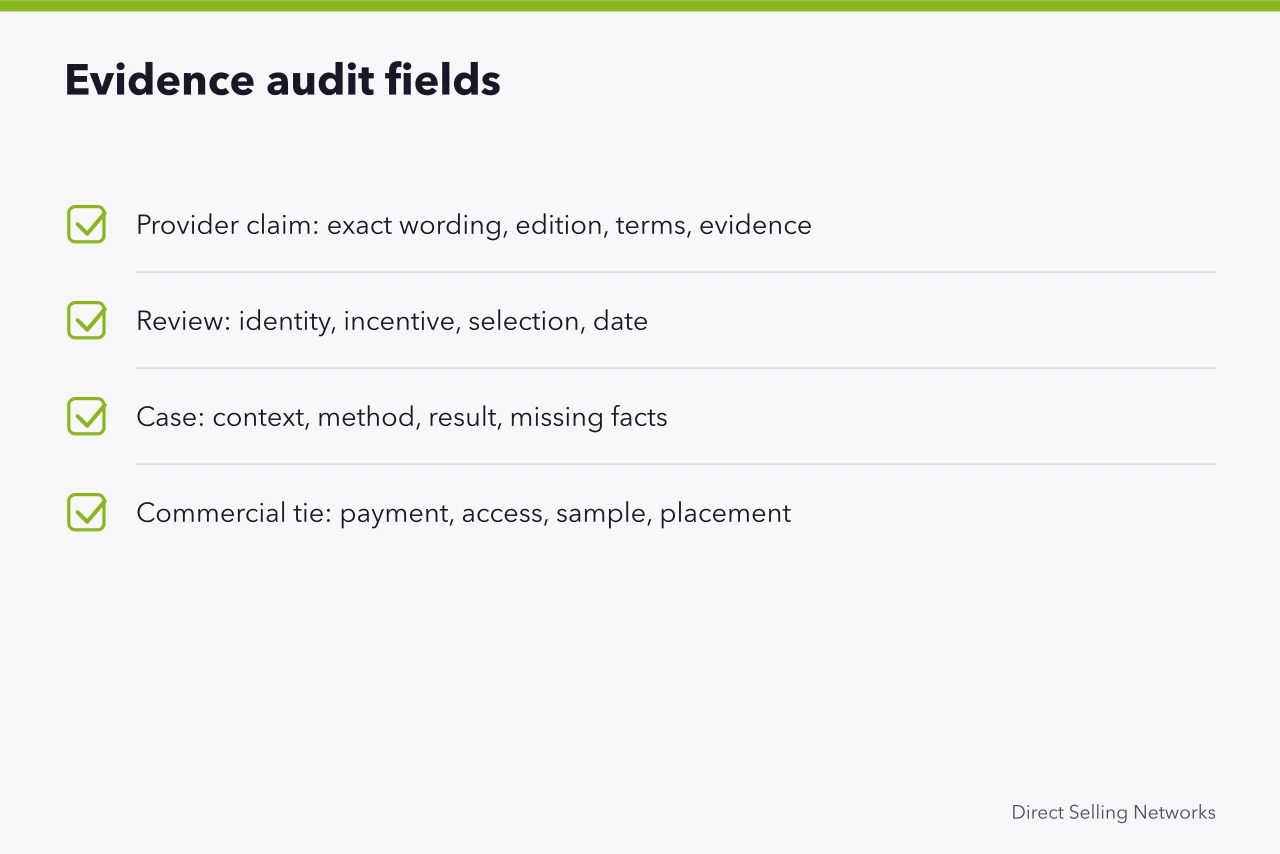
The FTC guidance for marketers using reviews warns about fake feedback, selective requests, conditioned incentives, hidden relationships and paid ranking. Use those checks before you name a provider in your own recruiting material.
Worked example: scoring two providers
A distributor compares two programs on the same six fields.
Provider A
- Refund rate, 12 months
- 4%
- Completion rate
- 61%
- Rank attainment, 12 months
- 9% of students
- Paid by a plan it teaches
- No
- Compensation plan supplied
- Yes, current
- Exit interviews offered
- Two
Provider B
- Refund rate, 12 months
- Declined to state
- Completion rate
- 22%
- Rank attainment, 12 months
- Not tracked
- Paid by a plan it teaches
- Yes, undisclosed
- Compensation plan supplied
- Slide only
- Exit interviews offered
- None
Provider A answers the checklist. Provider B does not. The decision writes itself. Those figures come from a worked comparison exercise, not a published audit of any provider. If you want the questions distributors ask most often when they start this comparison, see common network marketing training questions.
Common questions
What is the first decision when vetting a training company?
Define who owns the training, who the audience is, and what outcome would make you stop paying. Without a stop rule you will renew on habit.
How do I judge whether a program works?
Measure task demonstration and field quality at ninety days, next to cost. Keep the exclusions and the source limits in the file.
What should a team avoid?
Counting attendance as proof of ability. If a claim turns out to be wrong, correct the record where the error appeared. For a broader look at how distributors pick programs, see network marketing training.