

Reviews
Part of How Companies Can Assess Network Marketing Retention
Answering the network marketing retention questions in plain terms
The retention questions distributors and small direct selling teams actually ask, with the numbers to check, the simple records to keep, and fixes.
What to take away
- Network marketing retention is measured on voluntary continuation: distributors who stay without buying to protect rank or a downline position.
- Track 30, 90 and 180 day survival by enrollee cohort, not one blended annual rate.
- Autoship volume and active customer orders are different numbers; report both.
- The FTC requires a reasonable basis for objective earnings and lifestyle claims before you publish them.
- Keep the income disclosure statement current, and check state statutes where you recruit.
The questions people actually ask
How long do new distributors stay?
Why do they leave?
Track the top reason by cohort. If kit cost leads, test a starter kit under $50 or a payment plan.
Is retention the same as recruitment quality?
Does autoship inflate retention?
What support actually moves the number?
The records that make the answers checkable
| Field | What to record | Test |
|---|---|---|
| Cohort | Enrollment month and sponsor | Every enrollee assigned, none dropped |
| Activity | Qualifying order date and value | Date stamped at entry |
| Exit reason | Coded from the interview | Coded within 14 days |
| Cost | Lead cost plus onboarding cost per recruit | Divided by day-90 survivors |
| Claim | Any earnings figure published | Matched to the current disclosure statement |
| Autoship share | Autoship orders and active customer orders | Reported separately each month |
| Sponsor contact | Date of first and third sponsor contact | Logged within 72 hours |
What the rules require
The FTC's advertising substantiation policy applies to income and lifestyle claims. It applies the same way to any objective claim. You need a reasonable basis before you publish. The evidence must match the claim as a reasonable consumer reads it. Average means average, and the disclosure statement has to be current.
Several state attorneys general and state statutes add their own income-claim and disclosure requirements, and they differ by state. Confirm with your state regulator or a licensed attorney before you publish a number. Nothing here is legal advice.
Testing a change before you roll it out
Use a defined cohort and a comparison group rather than changing onboarding for everyone at once. The NIST guidance on selecting an experimental design starts from the objective and the practical constraints, which is the right first step: decide whether you are describing what happened or estimating an effect.
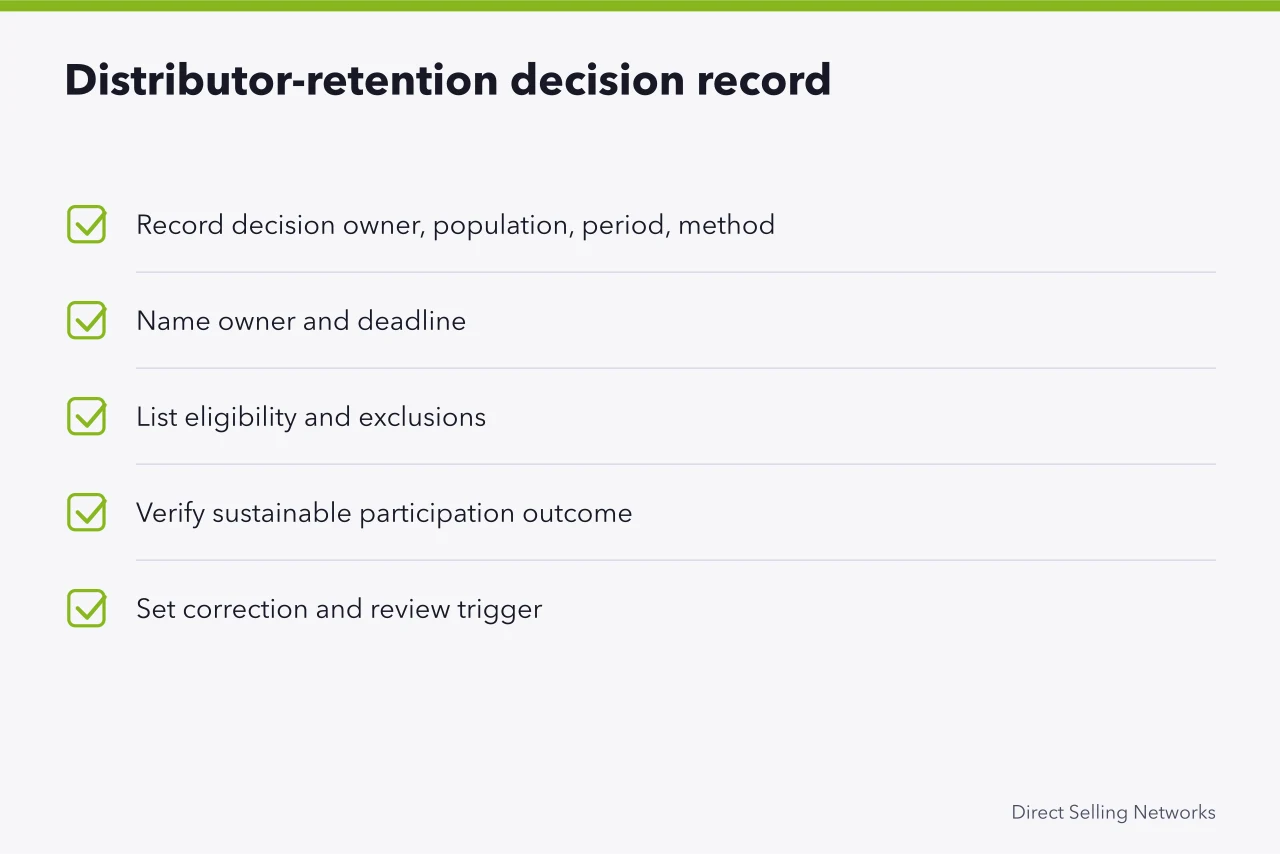
- Fix the population and the comparison basis before you start
- Track day-30 and day-90 survival alongside cost and order quality
- Follow one normal onboarding path and one exit path end to end
- Keep the claims, inputs and version dates with the result
- Write the stop rule and the next review date in advance
Record uncertainty. A two-point improvement in a cohort of forty is noise. Use at least 100 enrollees per group when you can.
Choosing the software that holds the data
If you are comparing CRM or autoship platforms, see the GOV.UK guidance on choosing technology. It is written for public services, but its tests transfer. These tests are: can you export your distributor and order data, who owns it, what does it cost to leave, and what is the security review.
The GOV.UK guidance on open standards makes the portability case plainly. Vendor lock-in is a retention risk when you cannot move a downline record.
Common options include Exigo and DirectScale for direct selling commissions and autoship, Salesforce and HubSpot for CRM, and Klaviyo for email automation. Exigo and DirectScale quote custom pricing.
Salesforce Starter typically costs about $25 per user per month. HubSpot's free CRM covers basic contacts, with paid seats often around $20 per user per month. Klaviyo's free plan covers up to 250 contacts and 500 email sends, with paid plans typically from about $20 per month.
Common questions
How often should retention be reviewed?
Monthly for cohorts, quarterly for the trend. Review the day-30 and day-90 curves together, because a flat annual number will not show a problem that started six weeks ago.
What counts as a retained distributor?
One who placed a qualifying order in the period without buying solely to protect rank or a position. Define the qualifying order in writing and apply it the same way to every cohort.
When should a retention claim be pulled?
When the underlying cohort data no longer supports it, or when the disclosure statement it cites is out of date. Correct the published figure and note the date of the correction.
What is the first fix if day-30 survival is low?
Shorten the time to first order. Assign a named sponsor, set a first-order goal under $100, and make contact within 72 hours. If kit cost is the top exit reason, test a starter kit under $50 or a payment plan.
Which retention number do leaders watch?
Day-90 survival by cohort and cost per day-90 survivor. A team can grow sign-ups while day-90 survival falls, which raises cost per active distributor.
For teams that want a structured plan rather than ad hoc fixes, how to improve network marketing retention walks through the onboarding and follow-up changes that show up in cohort data.