
Rules
Part of Network marketing lead generation: qualify and measure
How to improve network marketing lead generation
Consent-based, traceable lead generation for network marketing comes down to five practical tactics, measured by accepted leads, sign-ups, and recruits.
What to take away
- Consent is the asset. For network marketing lead generation, a list you bought has no permission attached, so it cannot be worked.
- Five tactics carry most distributor lead flowreferrals, content, social, a capture funnel, and structured follow-up.
- Measure accepted leads and downstream customers, not raw form fills.
- Log where each inquiry came from and when permission was given.
- Never reward volume alone. Paying per form fill buys you junk.
- Free tiers cover a small teamKit to 10,000 subscribers, MailerLite to 1,000, Zoho CRM to three users.
!Distributor reviewing lead source records and follow-up notes at a desk
Start with permission, not volume
A lead is a person who agreed to hear from you and can be traced back to that agreement. Everything else is a name on a list.
Consent-Based vs Bought Lists
Consent-based lead
- Opt-in
- Agreed to hear
- Traceability
- Source and date
- Outreach
- Expected contact
- Complaints
- Low
- Legal risk
- FTC rules met
Bought list
- Opt-in
- Never opted in
- Traceability
- CRM cannot show
- Outreach
- Reads as spam
- Complaints
- Rate climbs
- Legal risk
- Enforcement target
Bought lists fail on both counts. The people on them never opted in, so outreach reads as spam and the complaint rate climbs. Your CRM also cannot show where the name came from or when consent was given.
That matters beyond deliverability. The FTC and state attorneys general treat deceptive recruiting and earnings claims as enforcement targets. The FTC's Income Disclosure Guide sets out how income claims must be presented. Confirm current requirements with the FTC and your state attorney general before you write any recruiting script.
Two rules set the floor. The FTC's Business Opportunity Rule, at 16 CFR 437, requires a disclosure document and a cooling-off period for many business pitches. Its January 2018 guidance on multi-level marketing explains when that applies. The Direct Selling Association's code of ethics adds a written income representation standard for members.
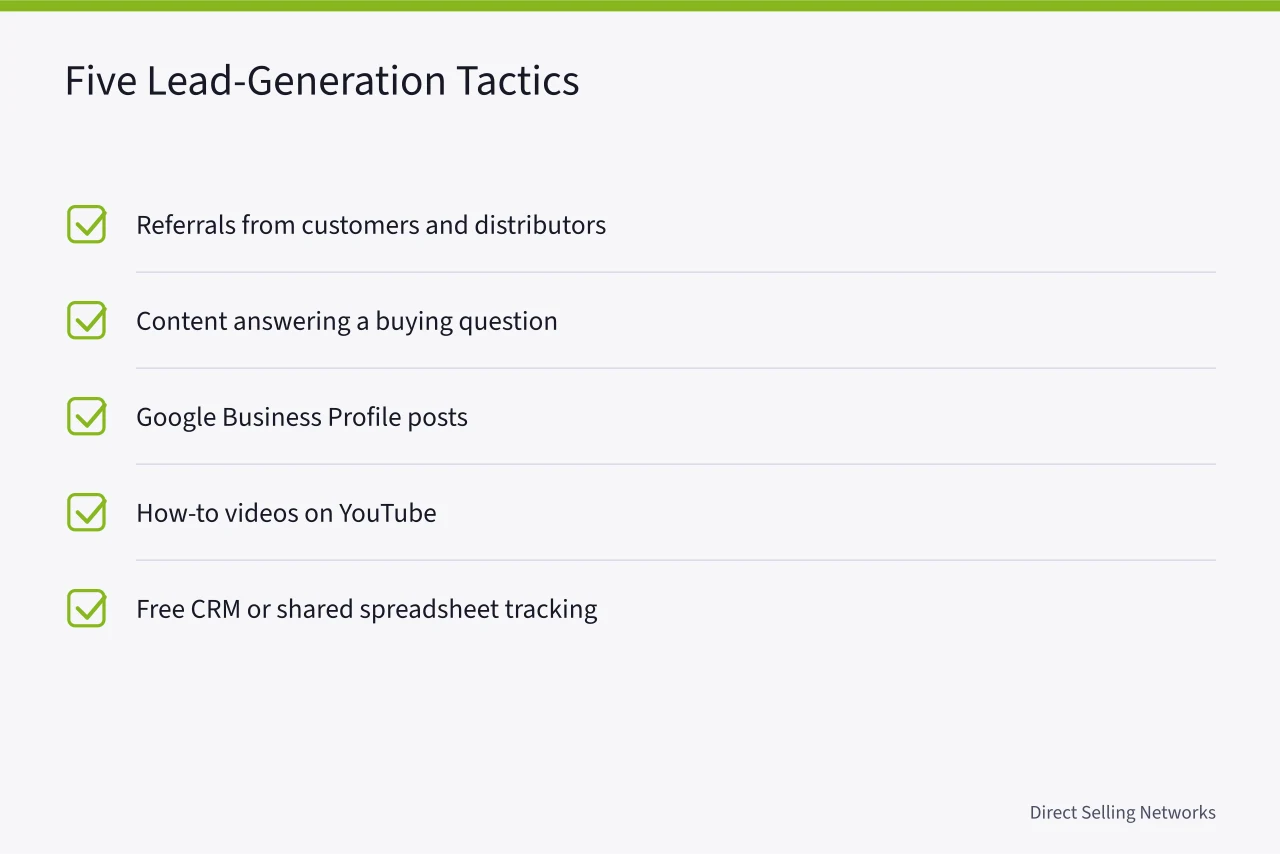
Five lead-generation tactics worth running
1. Referrals from existing customers and distributors
Ask a satisfied customer for one name, at the moment the product worked for them. A referral arrives with trust attached and converts far better than cold traffic.
Run it as a habit, not a campaign. Every distributor asks after every good outcome, and the name goes into the CRM with the referrer recorded.
Wording that works: name the result they mentioned, then ask who else has the same problem. One name per ask beats a request for three.
The record is simple. HubSpot's free CRM stores contact, source and deal stage at no monthly cost. Zoho CRM's free plan covers up to three users. A shared spreadsheet handles a team under ten.
2. Content that answers a buying question
Publish the questions your prospects actually type: what the product costs, how the compensation plan pays, what the starter kit contains. One honest answer per page.
Find the questions with free tools. Google Keyword Planner works with a free Google Ads account and gives monthly search volume by metro area. AnswerThePublic returns autocomplete questions on a free daily quota.
Content compounds. A page that ranks keeps producing inquiries after you stop working on it, which no paid channel does.
Google Business Profile posts cost nothing and appear in local results. A how-to video on YouTube answers the same question for buyers who prefer video.
3. Social platforms, worked as conversation
Pick one platform and post consistently. Show the work: a product in use, a training session, a distributor's first sale.
Facebook groups produce a steady share of inquiries, but many group rules ban recruiting outright. Read the rules and ask the admin before you post.
On Instagram Reels and TikTok, short video reaches people who do not follow you. Keep the opening message general and move the pitch to the direct message.
Meta's ad policies restrict income and personal-attribute claims. TikTok requires the branded content toggle on paid partnerships.
Comment replies and direct messages are where the inquiries come from. Broadcasting alone produces followers, not leads. Check each platform's current rules on business promotion before you post.
4. A capture funnel with one clear next step
A funnel is a page plus a form plus a follow-up sequence. The page makes one offer, the form asks for the minimum, and the sequence delivers what was promised.
Free plans cover most small teams, at the limits published in 2026. Kit, formerly ConvertKit, is free to 10,000 subscribers, with paid tiers from roughly $25 to $33 a month. MailerLite covers 1,000 subscribers and 12,000 emails a month free. Systeme.io hosts the page, form and emails free to 2,000 contacts.
Page builders cost more. ClickFunnels starts near $97 a month and Leadpages near $49 monthly, less on annual billing. Those are published list prices as of 2026, so confirm before you buy.
Keep the offer specific. "Free guide to the starter kit" beats "learn more about the opportunity."
5. Structured follow-up
Most inquiries are lost to silence, not to a competitor. Set a cadence: contact within a day, again in three, again in a week, then move to a nurture list.
Two tools remove friction. Calendly's free plan handles one event type, and paid seats run near $10 to $12 a month. Zoom's free tier caps group meetings at 40 minutes, enough for a first conversation.
Record every touch in the CRM. Follow-up without records is guesswork.
Where these tactics go wrong
Two failure modes show up repeatedly.
Two Failure Modes to Avoid
Are you buying a list?
Seller cannot show consent; domain reputation pays
Check what you reward
Buying lists. The seller cannot show consent, the names are stale, and your domain reputation pays for it. There is no version of this that works.
CAN-SPAM works on an opt-out basis, so a bought list can be legal to email. It still needs a working unsubscribe and a physical address, and complaint rates land on your sending domain.
Rewarding low-quality form fills. If a distributor is paid per lead captured, they will capture leads that never convert. Pay on accepted leads, or on recruits who reach a defined milestone, such as three straight months with a reorder.
The network marketing lead generation overview covers the channel mix in more detail.
What to measure
Track the funnel from inquiry to customer, and keep cost beside quality.
Funnel Metrics to Record
- Inquirysource, date, consent basis
- Accepted leadqualified by stated criteria
- Downstream customerpurchase or recruit, with date
- Cost per accepted leadspend divided by accepted leads
- Cost per recruitspend divided by milestone recruits
- Tool spendsubscription, list size, seat count
| Stage | What to record | Why |
|---|---|---|
| Inquiry | Source, date, consent basis | Proves permission and shows which tactic works |
| Accepted lead | Qualified by your stated criteria | Separates real interest from a form fill |
| Downstream customer | Purchase or recruit, with date | Ties spend to revenue, not activity |
| Cost per accepted lead | Spend divided by accepted leads | Compares tactics on the same basis |
| Cost per recruit | Spend divided by recruits who hit a milestone | Shows whether quality holds deeper in the funnel |
| Tool spend | Subscription, list size, seat count | Free tiers change, so record what you actually pay |
Cost per accepted lead is your own arithmetic. Take total spend on a tactic and divide it by the number of leads that met your qualification criteria. Do the same for cost per recruit.
Write the criteria down before you spend. "Replied, answered two qualifying questions, and booked a call" is a usable definition. "Seemed interested" is not.
Keep records you can defend
Log access, changes, failures, and corrections for any system holding prospect data. The CISA logging guidance for small businesses explains why event records are retained and reviewed.
Records You Can Defend
- Log access, changes, failures, corrections
- Define test population and comparison first
- Use NIST AI RMF actionsgovern, map, measure, manage
- Treat open standards as a portability prompt
- Keep records to answer CCPA and CPRA deletion requests
Logs show what happened in a system. They do not prove a lead converted, and they are not evidence of a business result.
If you test a new tactic, define the population and the comparison before you start. NIST guidance on selecting an experimental design starts with the objective and the practical constraints, which is the right order.
Where a tool touches prospect data, the NIST AI RMF Playbook lists voluntary actions under govern, map, measure, and manage. It is not a certification.
If you are choosing vendors or building shared data formats, the GOV.UK open standards guidance explains interoperability and reduced supplier dependence. It governs UK public-service work, so treat it as a portability prompt only.
California's CCPA and CPRA let residents see and delete personal data, though the revenue thresholds exclude most individual distributors. Keep enough records to answer a deletion request anyway.
A worked check on one tactic
Worked Check on One Tactic
- Caseone tactic, one month, population and dates
- Consentscreenshot opt-in wording and date
- Methodcount inquiries, accepted leads, customers
- Outcomecompare cost per accepted lead
- Budgetcap at $100 to $300 or ten hours weekly
- Stop rulestop if consent or criteria fail
| Field | Test | Record |
|---|---|---|
| Case | Pick one tactic and one month | Population, dates, reviewer |
| Consent | Screenshot the opt-in wording and its date | Wording, source URL, timestamp |
| Method | Count inquiries, accepted leads, and downstream customers. Repeat with the follow-up step removed. | Inputs and observations |
| Outcome | Compare cost per accepted lead against your other tactics | Figure, plus quality notes |
| Budget | Cap the test at $100 to $300, or ten hours a week | Spend and hours |
| Stop rule | Stop if the source cannot show consent, or if leads fail your criteria | Correction owner and review date |
Common questions
What is the first decision in improving lead generation?
Decide who owns lead generation and what counts as an accepted lead. Without that definition you cannot compare tactics or spot a bad source. If you are still weighing the basics, the network marketing lead generation questions, answered plainly walk through the decisions that come first.
How should results be reviewed?
Review accepted leads and downstream customers together, with cost and quality. Record the source, the consent basis, and any tactic you dropped.
What should a team avoid?
Avoid bought lists and paying on raw form fills. If a source cannot show consent, stop using it and correct any outreach already sent.
Do these rules vary by state?
Yes. Recruiting language, income claims, and disclosure duties differ by state. Confirm current requirements with the FTC, your state attorney general, and a licensed attorney. For tax treatment of distributor income, see the IRS or a CPA; Canadian distributors should check CRA guidance on T2125.