Operations
Part of Direct selling: a focused business guide for 2027
How to improve direct selling results without cutting corners
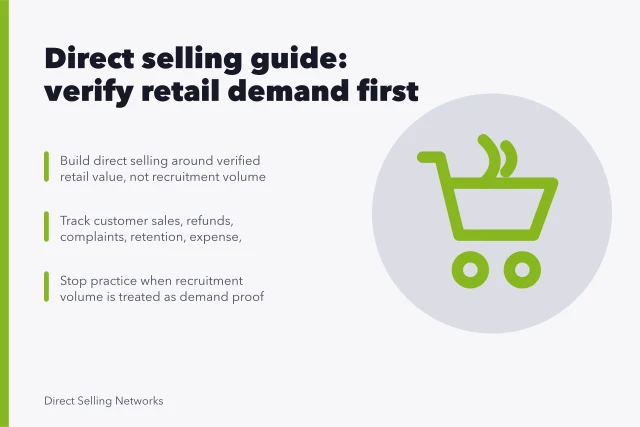
Direct selling improves when retail sales, refunds, complaints and recruitment quality are tracked, and recruitment volume is never treated as proof of demand.
What to take away
- A distributor who buys stock to hold a rank is not a customer. Track retail sales to people outside the field.
- Keep refunds, complaints and reorder rates in the same ledger as sales. A high return rate cancels a strong recruitment month.
- The FTC and state attorneys general set income-claim and disclosure rules. Confirm your language with them before publishing.
- Treat recruitment volume as a recruitment number, never as evidence that customers want the product.
- Set a stop rule before the next promotionif retail sales fall while recruits rise, the plan is loading inventory.
What separates direct selling from inventory loading
Direct selling is selling a product to a person who will use it. Inventory loading is selling it to a distributor who will store it.
Direct Selling vs Inventory Loading
Direct selling
- Who buys
- End user
- Product moves
- To consumer
- Income source
- Retail movement
- Recruitment report
- Looks identical
- Retail ledger
- Shows customers
Inventory loading
- Who buys
- Distributor stores
- Product moves
- To warehouse
- Income source
- Kit purchases
- Recruitment report
- Looks identical
- Retail ledger
- Shows no sales
Recruitment-only
- Who buys
- New enrollee
- Product moves
- Rarely to consumer
- Income source
- Enrolling people
- Recruitment report
- Looks like growth
- Retail ledger
- Shows no demand
The two look identical on a recruitment report. They separate on a retail ledger. A distributor who bought a starter kit and never sold to anyone outside the field is a purchase, not a customer.
Recruitment-only behavior is the third pattern. A program that pays mainly for enrolling people, with little or no requirement that product reaches an end user, is the shape regulators examine. The direct selling model is lawful when product moves to consumers and income comes from that movement.
The numbers that show whether customers exist
Pull these from your own system. No benchmark replaces them.
- Retail sales to non-distributors, by month and by distributor
- Refund and return rate, as a share of retail sales
- Complaint count and the reason for each
- Reorder rate among retail customers, not among distributors
- Autoship volume split between active sellers and inactive accounts
- Recruits who made a retail sale within 90 days
If reorder rate among retail customers is near zero, the product is not being consumed. Autoship orders sitting on inactive accounts are the clearest sign of loading.
A monthly retail ledger
| Field | What to record | What it tells you |
|---|---|---|
| Retail sales | Units sold to non-distributors | Whether customers exist |
| Refunds | Value and reason | Whether the product or the pitch failed |
| Complaints | Count, source, resolution | Where the promise broke |
| Retention | Retail customers who reorder | Whether the product holds |
| Recruitment | New enrollees and their first retail sale | Whether growth is real |
Run this monthly and keep the source date beside each figure. A recruitment spike with flat retail sales is a warning, not a win.
The stop rule
Write the stop rule before the next promotion, while no one is defending a number.
An example: if retail sales fall for two consecutive months while new enrollees rise, pause recruitment incentives and audit the top enrolling legs. Name who can pull the trigger.
The GAO evaluation design guide connects an evaluation question to the evidence it needs. Apply that discipline to your own numbers, and do not claim cause where your data cannot show it.
Data quality matters here. The GAO data reliability guide ties data quality to its intended use and asks for a documented assessment. Record what your ledger can and cannot support before you act on it.
Claims, reviews and vendor checks
Income claims are the fastest route to a state attorney general inquiry. The FTC sets the federal standard for earnings representations, and state statutes add their own. Confirm your income disclosure and recruiting language with the FTC and your state regulator, or with a licensed attorney, before it goes out.
Review integrity is part of the same file. The FTC guidance for marketers using reviews covers fake feedback, selective requests, conditioned incentives and hidden relationships. Those checks apply to distributor testimonials and to any ranking you publish.
If you buy recruiting or lead software, the CISA software acquisition fact sheet lists supply-chain and vulnerability questions to ask. Add the answers to the purchase record. They are diligence, not approval.
Common questions
What is the first decision in improving direct selling results?
Decide what counts as a customer. Define a retail sale as a sale to someone outside the distributor field, then build every other measure on that definition. Without it, recruitment numbers will keep standing in for demand.
How often should the retail ledger be reviewed?
Monthly, with the source date on each figure. Review retail sales, refunds, complaints and retention together, because a strong month in one can hide a failure in another. Record the decision and who made it.
What should a team avoid?
Avoid treating recruitment volume as proof that customers want the product. Also avoid publishing income claims you cannot substantiate. If an error reaches a public page, correct it and note the date.
Where do the compliance rules come from?
The FTC sets federal standards for earnings claims and endorsements, and state attorneys general enforce their own statutes. Requirements differ by state. Confirm your specific language with the FTC, your state regulator, or a licensed attorney.