Costs
Part of Network marketing strategy: what to keep and what to drop
Strategy practices that keep network marketing plans grounded
Retail demand, repeat customers and evidence-backed product claims are strategy practices that keep any network marketing plan grounded and defensible.
What to take away
- A network marketing plan is grounded when it can show repeat retail customers, not recruiting volume.
- Run the compensation math on your own numbers before a recruit hears it.
- Every income or lifestyle claim needs the document that supports it on file before it is published.
- FTC guidance and state consumer protection statutes treat earnings representations as advertising claims.
- Distributor classification turns on behavioral and financial control, not on the contract's label.
- Test one practice against a comparison period before you scale it.
Ground the plan in retail demand first
A network marketing plan rests on people who buy again without being asked. Recruiting volume hides a weak retail base, because a new distributor's starter order looks like revenue until month three.
Customer vs. Transaction
Reorders twice
- Status
- Customer
- Retail base
- Strong
- Downstream
- Stable
- Regulator view
- Sales to consumers
Buys once
- Status
- Transaction
- Retail base
- Thin
- Downstream
- Churn, refunds
- Regulator view
- Wholesale purchases
Track two numbers monthly: active retail customers, and the share who reorder. A customer who reorders twice is a customer. One who buys once is a transaction.
That distinction decides everything downstream. Recruiting targets set against a thin retail base produce churn, refunds and complaints, and those complaints are what regulators read first. The FTC's Business Guidance Concerning Multi-Level Marketing (January 2016) puts the rule plainly: pay has to track sales to ultimate consumers, not wholesale purchases by participants.
The Direct Selling Association, the U.S. trade body, requires members to follow its Code of Ethics and has encouraged them to publish income disclosure statements. Amway's Income Disclosure Statement and Herbalife's Statement of Average Gross Compensation are two that do. Both report that most distributors earn modest amounts. Read one before you set a recruiting target.
Run the compensation math before you promise anything
Before a recruit hears a number, run the plan on your own figures. Write the arithmetic in variables you substitute: rank volume (V), personal volume (P), downline volume (D), payout rate (R), monthly autoship cost (A).
FTC Penalties for Loose Math
- 200 millionHerbalife 2016
- 150 millionAdvoCare 2019
Then answer three questions. What does a distributor earn at V with R applied? What does the same distributor pay in A to stay qualified? How many months of A does a new recruit fund before the first commission?
If the third answer is longer than the recruit's savings, the pitch is a promise you cannot keep. Say so in the recruiting conversation, not after.
Two FTC cases show what loose math costs. FTC v. Herbalife (2016) ended with a $200 million payment and a restructured pay plan; FTC v. AdvoCare International (2019) ended with $150 million. In each case the agency examined how pay was actually calculated.
Stop income and lifestyle promises without evidence
The FTC treats an earnings claim as an advertising claim. It must be truthful, non-misleading, and backed by evidence that reflects what typical participants actually earn. The FTC's own guidance on income claims and the applicable state statutes are the authorities; a licensed attorney reads them for your jurisdiction.
Placement matters as much as wording. The FTC's .com Disclosures guidance (2013) says a disclosure must be clear, conspicuous and near the claim. The Endorsement Guides at 16 CFR Part 255 cover testimonials and social posts, where a hashtag alone rarely counts as notice.
Three practices keep this clean:
- Publish an income disclosure statement using the median, not the top earner, and state the period it covers.
Clean Income Claim Practices
- Publish median income disclosure with period
- Ban unsupported lifestyle imagery
- Keep claims and documents dated and owned
- Check state UDAP statute thresholds
State attorneys general enforce their own consumer protection statutes alongside the FTC, and the thresholds differ by state. Most do it through UDAP statutes, sometimes called little FTC acts. Name your state and check its statute rather than assuming the federal standard covers you.
Vet the tools that touch distributor data
Lead vendors, CRM platforms and autoship systems all hold distributor and customer records. Before purchase, check what the vendor does with that data and who can access it.
Vendor Tool Costs
Tool
- Zoho CRM Standard
- $14/user/month
- HubSpot Starter
- $20/seat/month
- Mailchimp Essentials
- $13/month 500 contacts
- Recharge standard
- $99/month plus fee
List price
- Zoho CRM Standard
- HubSpot Starter
- Mailchimp Essentials
- Recharge standard
Entry seats stay cheap, so the review is about terms. Zoho CRM's Standard plan lists at $14 per user per month billed annually. HubSpot's Starter Customer Platform runs about $20 per seat per month.
Mailchimp Essentials starts near $13 per month for 500 contacts. Recharge, an autoship app for Shopify stores, lists a standard plan near $99 per month plus a transaction fee.
Ask each vendor for a data processing addendum, a SOC 2 Type II report and a written answer on whether customer records train any model. File all three with the contract.
The CISA software acquisition fact sheet lists the checks buyers should run: development practice, supply-chain exposure, deployment and vulnerability management. Put those answers in the purchase record. They are inputs, not approval.
For privacy risk, the NIST Privacy Framework starting guide describes a voluntary process for identifying risk, assigning owners and recording responses. It is a management aid, not legal clearance for a marketing use.
Accessibility belongs in the same review. The W3C explanation of information and relationships holds that visual structure must also be available programmatically. Test the actual enrollment form, disclosure table and distributor dashboard, not a sample page. A recruit who uses a screen reader has to complete that enrollment form alone.
Test one practice before you scale it
Pick one practice, one population, one period. Choose the metric the change is meant to move: reorder rate, refund rate, complaints or cost per recruit. Run the practice during ordinary work and once under a controlled failure, then compare.
| Field | Test | Record |
|---|---|---|
| Case | One recruiting script or disclosure page, named | Population, dates, reviewer |
| Method | Observe one normal cycle and one failure cycle | Inputs, outputs, response time |
| Comparison | Prior period or a matched group that did not get the change | Sample size, dates, what differed |
| Outcome | Retail reorders, refunds, complaints, cost per recruit | Change against prior period |
| Escalation | Any unsupported income or lifestyle claim | Pause, correction owner, closure date |
Evaluation design matters here. The GAO evaluation design guide connects evaluation questions to evidence needs and design choices, which is the discipline that keeps a small test honest. Do not claim cause from a before-and-after with no comparison basis.
For a worked example: a team raises its autoship discount to lift retention. Reorders rise, but so do refunds. Without a comparison group, the team cannot tell whether the discount worked or the refund policy changed. Record the uncertainty and rerun.
Common questions
What is the first thing to fix in a weak plan?
Retail reorder rate. If customers do not buy twice, no compensation plan, script or tool will hold the organization together, and every recruiting target built on top of it will fail.
How often should the plan be reviewed?
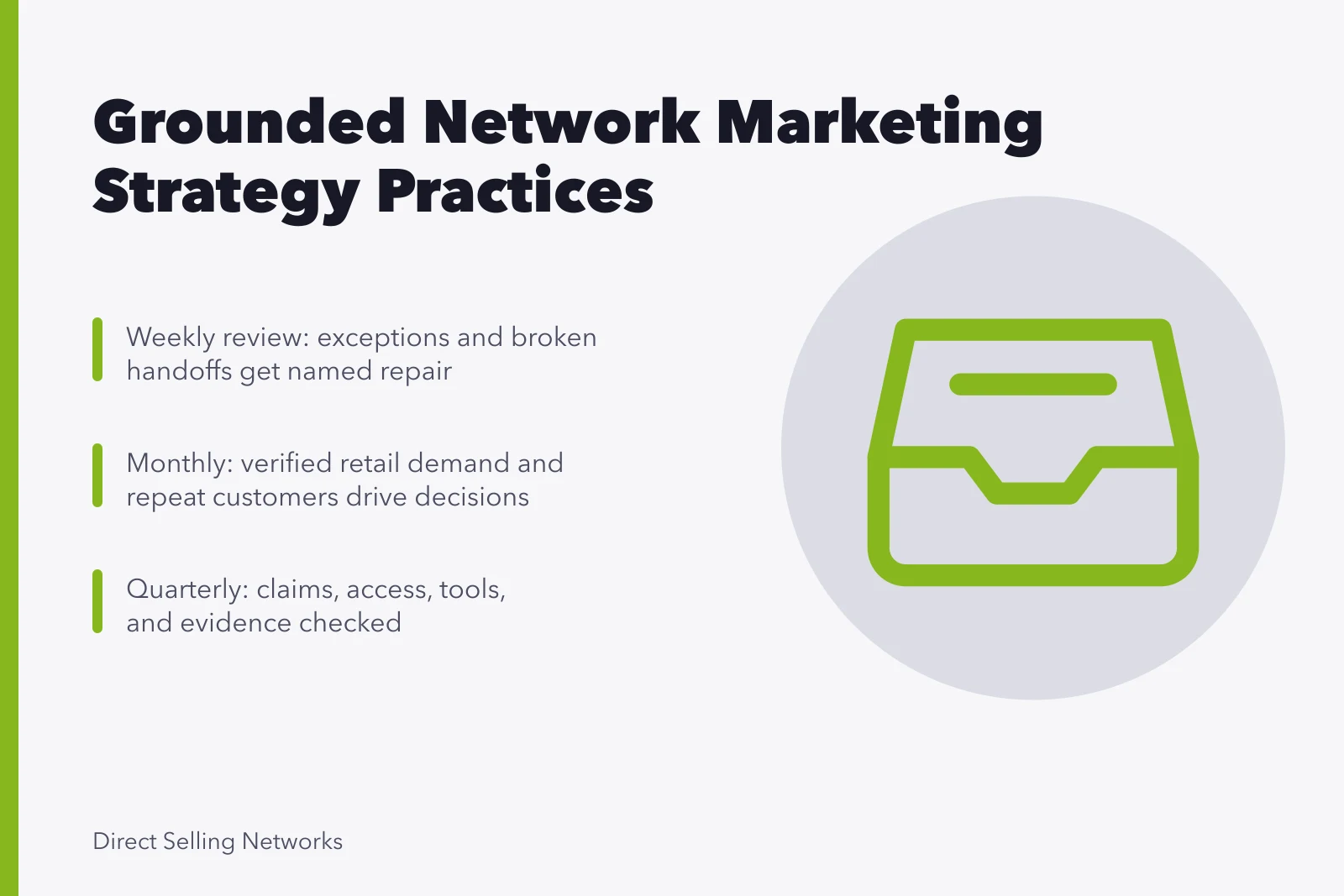
Monthly for retail and reorder numbers, quarterly for claims, disclosures and vendor access. Any unsupported income claim triggers an immediate pause rather than waiting for the quarterly cycle.
Who decides whether a claim is allowed?
The FTC sets the federal standard for earnings claims, and state attorneys general enforce their own statutes. For tax treatment of distributor income, the IRS in the United States and the CRA in Canada, or a licensed CPA, decide your situation.
What should a distributor never do?
Never publish an earnings or lifestyle claim without the document that supports it. Keep the claim, the evidence and the review date together, and route the question to a licensed attorney rather than answering it yourself.
For the wider set of decisions behind these practices, see common network marketing strategy questions, and for the plan structure itself, see network marketing strategy.