Strategy
Part of Network marketing strategy: what to keep and what to drop
Strategy benchmarks: what separates growing network marketing teams
Growing network marketing teams share measurable retail demand, retention and payout discipline, not motivational slogans or borrowed recruitment numbers.
What to take away
- Growing teams track verified retail demand and repeat customers, not recruits or rank advances.
- Five strategy benchmarks separate growing network marketing teams: 90-day repeat rate, autoship-to-retail split, cost per first retail sale, payout ratio and refund rate.
- A benchmark needs a population, a period, a denominator and a currency before it means anything.
- Income claims without evidence draw FTC and state attorney general attention. Herbalife's 2016 FTC settlement carried a $200 million payment.
- Autoship volume that never reaches a retail customer is the failure mode that ends programs.
- Every figure you cannot source belongs in a named variable the reader fills in.
What separates growing network marketing teams
Growing network marketing teams measure retail. Teams that stall measure enrollment.
That difference predicts most of what follows. A team counting recruits can hit a record month while its retail base shrinks. A team counting repeat customers cannot hide a shrinking base for long.
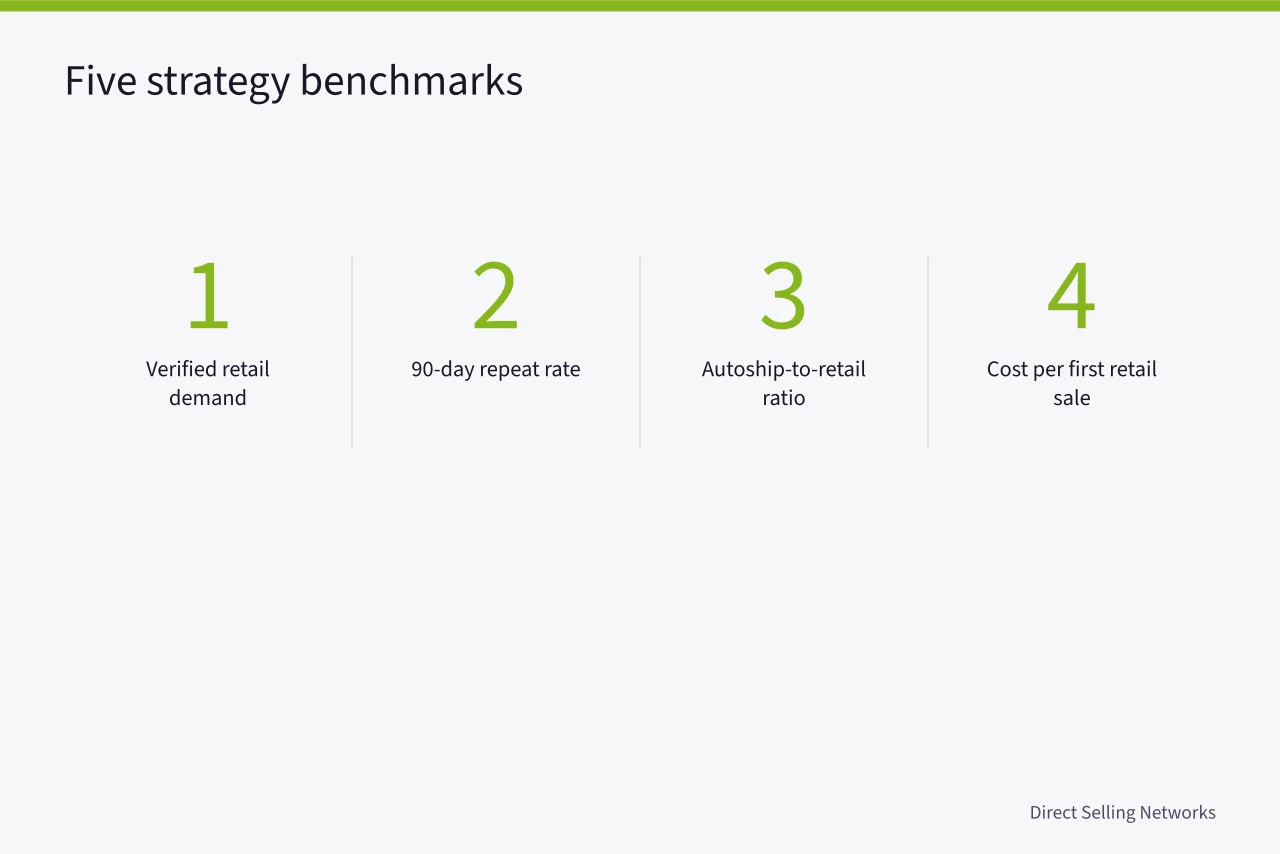
Five strategy benchmarks carry the weight here. Each one has a denominator you can defend.
- Verified retail demand: orders from people who are not distributors, tracked separately from internal volume.
- 90-day repeat rate: the share of retail buyers who order again inside 90 days.
- Autoship-to-retail ratio: how much autoship volume reaches a genuine end customer.
- Cost per first retail sale: lead and onboarding spend divided by the distributors who make one.
- Refund rate: returned retail dollars as a share of gross retail revenue, plus the reason codes.
Typical bands, labelled typical because no regulator publishes them: the 90-day repeat rate runs about 25% to 45% on consumable products and 10% to 20% on one-time starter kits. Consumability, subscription design and price point drive the spread, and single-purchase kits sit at the bottom of it.
A program where autoship volume sits far above verified retail demand is a program funding itself from its own distributors. That structure collapses when recruitment slows.
Where the numbers come from
No public body publishes a standard retention benchmark for direct selling. Anyone quoting one is quoting a vendor, an association survey or their own book. Say which, and date it.
Public filings beat vendor decks. Herbalife (NYSE: HLF), USANA (NASDAQ: USNA), Nu Skin (NYSE: NUS) and Primerica (NYSE: PRI) report distributor, customer or representative counts every quarter. Nu Skin splits customers from sales leaders in its earnings releases. Primerica's annual report gives its count of life-licensed representatives alongside the term life policies issued.
The Herbalife order is the clearest regulatory benchmark. The FTC's 2016 settlement required the company to treat its US Preferred Members as customers rather than distributors, and to report retail sales as a separate figure. Compare a team's retail share against that published split.
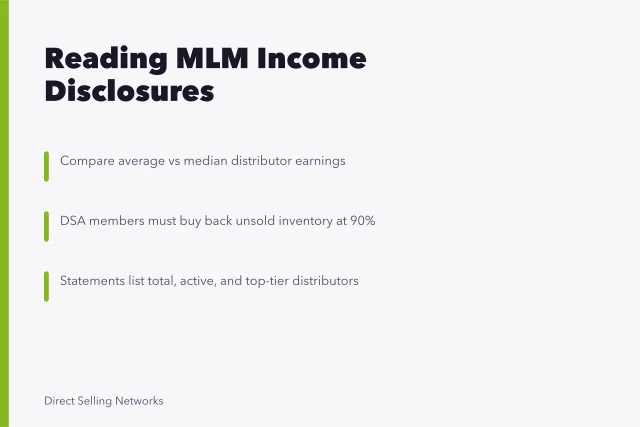
Amway, privately held by the DeVos and Van Andel families, publishes an income disclosure statement for its US independent business owners. Read the median for active distributors, not the ceiling of the range. The same advice applies to the disclosure statements from USANA, Nu Skin and Mary Kay.
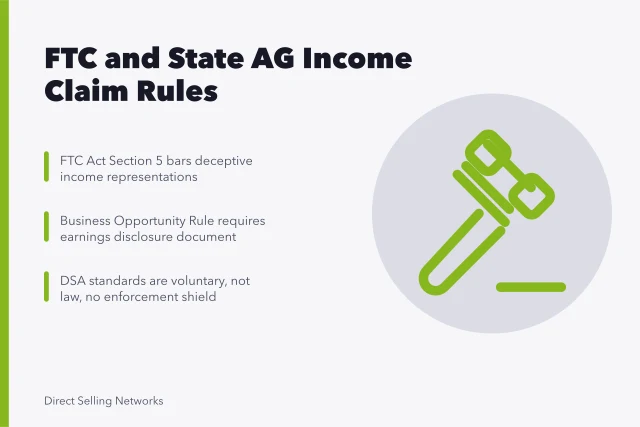
The FTC's business guidance on direct selling and the agency's income disclosure materials set the rules for what you may claim about earnings. State attorneys general enforce their own versions. Neither publishes a growth benchmark you can copy.
The Direct Selling Association, the US trade body, binds members including Amway, Herbalife, Mary Kay, Nu Skin and USANA to a published code of ethics with a complaint process. Confirm current membership on its site before you cite a company as a member.
For Canadian distributors, CRA form T2125 governs how business income and expenses are reported, and the deductions differ from the US 1099 treatment. A licensed CPA or attorney in the relevant jurisdiction decides which applies.
Where you lack a figure, write the arithmetic with variables you substitute:
- Repeat rate = repeat buyers in period ÷ total retail buyers in period
- Cost per recruit = total lead and onboarding spend ÷ distributors who reach first retail sale
- Payout ratio = total commission paid ÷ verified retail revenue
- Refund rate = refunded retail dollars ÷ gross retail dollars
Run those monthly. A trend line you built yourself beats a borrowed number you cannot check. A shared spreadsheet holds all four: Google Sheets is free with a Google account, and QuickBooks Online, typically $30 to $40 a month on list, holds the retail revenue figure if you invoice through it.
The compliance line that ends programs
An income or lifestyle claim without evidence is the fastest route from a growing team to a state AG inquiry. "Replace your salary" and "financial freedom" are claims, not encouragement.
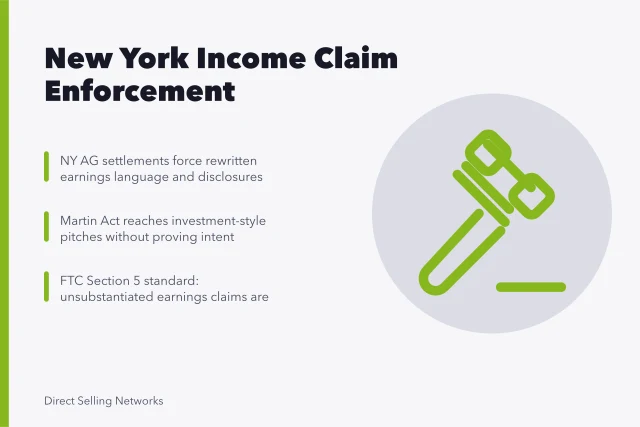
The FTC treats earnings representations as advertising claims that require substantiation. If typical results are modest, the claim must say so. Many states go further and require an income disclosure statement in a set format.
Two FTC cases mark the boundary. The 2015 action against Vemma alleged that rewards flowed mostly from recruitment and internal consumption, and the settlement banned that structure. The Ninth Circuit upheld the FTC's pyramid scheme ruling against BurnLounge in 2014.
Train recruiters on what they may not say. Keep the approved scripts in writing, dated, with an owner. When a distributor posts an unapproved claim, the correction belongs on the same channel where the claim appeared.
Testing a change before you scale it
Before you roll a new compensation tweak or onboarding sequence across a whole organization, run it on one defined group.
The NIST experimental design selection guidance starts with the objective and the practical constraints, which is the right order: decide what you are trying to move, then decide what you can afford to test.
Keep the test group and the comparison group comparable in tenure, market and rank mix. Record the start date, the maturity window and who owns the decision.
The NIST AI RMF Playbook is useful when a scoring tool or lead model changes who gets contacted first. It organizes voluntary actions under govern, map, measure and manage. It is not a certification and not a ranking, and its scope should stay visible.
If your team depends on a vendor platform, the GOV.UK open standards guidance is worth reading for one reason: it ties open standards to interoperability and reduced supplier dependence. That page governs UK public services, so treat it as a portability prompt, not a rule.
For the record-keeping side, the CISA guidance on logging for small business explains why organizations retain and review event records. Access, change and correction logs support an audit. They do not prove a business result.
A benchmark card you can fill in
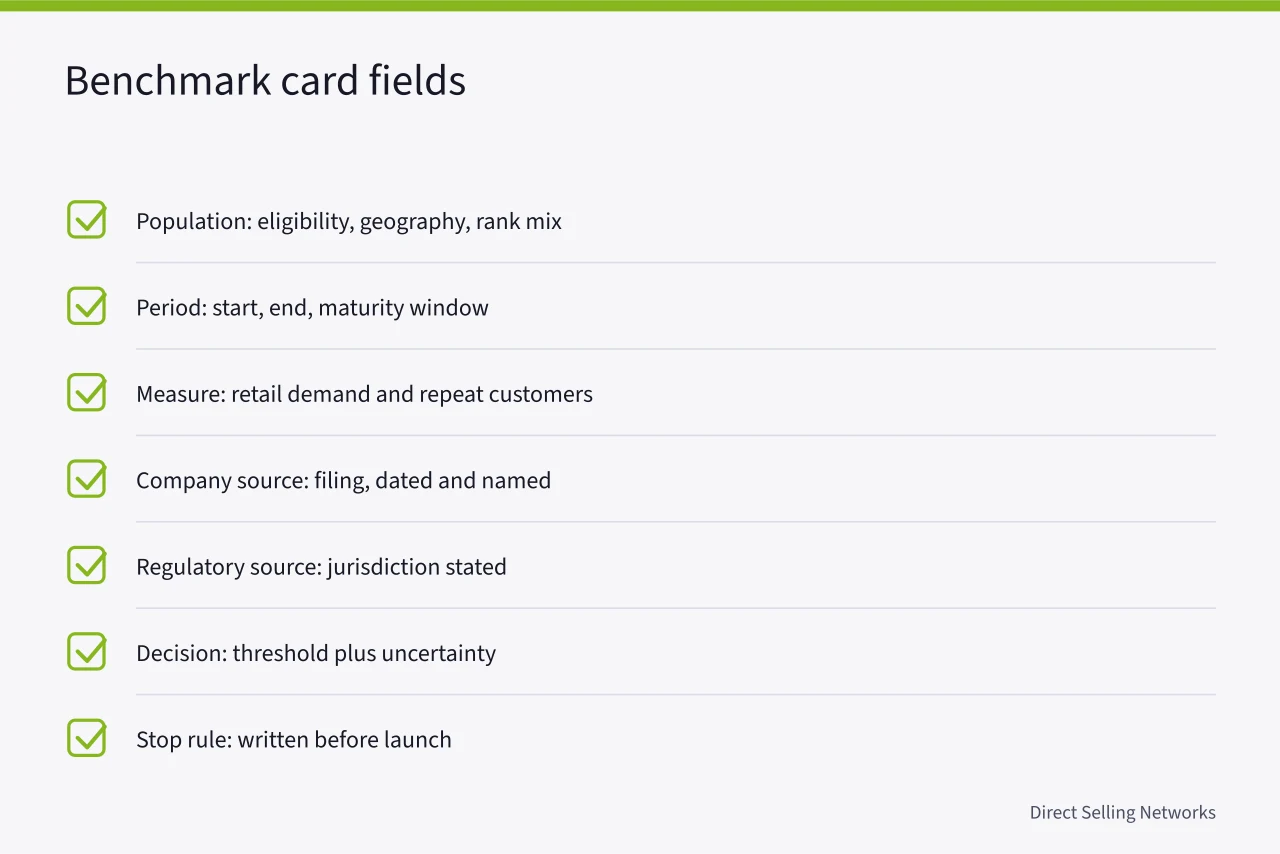
| Field | What to record | Acceptance test |
|---|---|---|
| Population | Eligibility, geography, rank mix, exclusions | Comparable group |
| Period | Start, end, maturity window, season | Comparable window |
| Measure | Verified retail demand and repeat customers | Same denominator both sides |
| Company source | Herbalife, USANA, Nu Skin or Primerica filing; DSA member code | Dated and named |
| Regulatory source | FTC business guidance, state income disclosure rule, CRA form T2125 | Jurisdiction stated |
| Decision | Retail value and responsible seller activity | Threshold plus uncertainty |
| Stop rule | What result ends the test | Written before launch |
Common questions
What is the first decision in benchmarking a network marketing team?
Decide what you are measuring and who owns the number. If the answer is recruits or rank advances, you are measuring activity, not growth.
How often should these measures be reviewed?
Monthly for the ratios, quarterly for the trend. Any review that does not end in a dated decision record is a report, not a review.
What should a team avoid?
Making income or lifestyle promises without evidence. Correct the claim where it appeared and keep the correction on file. Our network marketing strategy guide covers the planning side.
Where do the strategy questions come from?
Most teams hit the same handful of decisions about pricing, rank and retention. We collect them in common network marketing strategy questions.