
Careers
Part of Network marketing strategy: what to keep and what to drop
Network marketing strategy examples: five company models by mechanism and transfer limit
Network marketing strategy examples from Amway, Herbalife, Avon, Mary Kay and USANA, each broken into its mechanism, cost and transfer limit.
What to take away
- Expansion depends on a result you can reproduce with the people, rights, capacity, systems and budget you actually have.
- Amway, Herbalife, Avon, Mary Kay and USANA run five different network marketing models; each transfers only under matching conditions.
- Read every example for its mechanism, cost and transfer limit, not its headline result.
- The FTC requires a reasonable basis for objective claims before you publish them, not after.
- Record starting condition, constraint, action and observed result so a second person can repeat the test.
Amway, Herbalife, Avon, Mary Kay and USANA, taken apart
The title promises network marketing strategy examples, so here are five. Each entry gives the mechanism, a public cost signal, a public figure to check and the transfer limit.
Five Network Marketing Examples
Amway
- Mechanism
- Personal retail + team volume
- Public cost signal
- $50-$100 starter kit
- Transfer limit
- Needs wide active network
Herbalife
- Mechanism
- Retail profit + royalties
- Public cost signal
- $50-$150 kit + pack
- Transfer limit
- Recruitment strains without retail
Avon
- Mechanism
- Catalog and online commission
- Public cost signal
- Free sign-up, kit under $25
- Transfer limit
- Rewards personal selling
Mary Kay
- Mechanism
- Wholesale buy, retail sell
- Public cost signal
- $50-$150 starter kit
- Transfer limit
- Depends on local social networks
| Company | Mechanism | Cost signal to confirm | Public figure to check | Transfer limit |
|---|---|---|---|---|
| Amway | Independent business owners earn on personal retail sales and team volume. | Starter kit and business materials; an annual renewal may apply. | Income figures Amway publishes for its business owners; read the median for a rank. | Needs a wide, active network for team-volume income. |
| Herbalife | Distributors earn retail profit and royalties; repeat purchase drives volume. | Distributor kit and first product pack; monthly volume targets drive spend. | Published discount levels by rank, about 25% to 50% off retail; U.S. income disclosure statement. | Recruitment without retail demand strains the plan. |
| Avon | Representatives sell catalog and online; commission on personal sales. | Sign-up fee and starter kit vary by market; confirm with Avon. | Commission on personal sales rises with sales volume and varies by country; ask Avon for its current plan. | Rewards personal selling more than team building. |
| Mary Kay | Consultants buy wholesale and sell at suggested retail, often through parties. | Starter kit bought at wholesale; confirm the current price. | Wholesale near 50% of suggested retail. | Depends on local in-person social networks. |
| USANA | Associates earn through a binary structure; autoship supports repeat volume. | Associate kit; autoship and monthly product-volume qualification. | Statement of average gross compensation; rank and autoship volume set that average. | Autoship can mask weak retail demand. |
The cost signals in the table are items to confirm, not dated prices. This article gives no price figures because they change by market and year; get the current numbers from each company before you budget.
This article compares mechanisms and transfer limits. It does not measure how well each strategy performed, because no independent outcome data covers all five on the same basis.
Amway. Amway was founded by Jay Van Andel and Rich DeVos in 1959 in Ada, Michigan. Independent business owners earn on personal retail sales and on the volume of distributors they sponsor. The mechanism is a wide, deep network where income depends on team volume, not just personal selling.
Amway sells a starter kit and business materials, and an annual renewal fee applies in some markets, so confirm current prices before you commit. Amway publishes income figures for its business owners on its own site; read the median for the rank you are considering, not a recruiting slide.
The transfer limit: team-volume income needs a wide, active network, which a small local market may not support.
Herbalife. Herbalife was founded by Mark Hughes in 1980 and sells nutrition, weight-management and sports products. Distributors earn retail profit and royalties. The model favors daily consumption, which makes repeat purchase the core engine.
A distributor kit and first product pack are the entry cost, and monthly volume targets can drive ongoing spend. Herbalife publishes discount levels by rank, about 25% to 50% off suggested retail, and a U.S. income disclosure statement; read the median earnings it reports across all distributors.
The model suits a seller who can build a stable customer base; it strains a seller who recruits faster than they retail.
Avon. Avon was founded by David H. McConnell in 1886 and runs a representative model closer to catalog retail than to team building. Sign-up fees and starter kits vary by market, so ask Avon for current terms. Representatives earn commission on personal sales, and the rate rises with sales volume and varies by country, so ask Avon for its current plan.
It suits someone testing direct selling with minimal capital, and it rewards personal selling over recruitment.
Mary Kay. Mary Kay was founded by Mary Kay Ash in 1963 and uses a consultant model with a defined career path and an in-person demonstration culture. Consultants buy at wholesale and sell at suggested retail; the margin between the two is about 50% of the retail price.
Its mechanism is party-based selling and repeat skincare purchase, which depends on local social networks more than on digital reach.
USANA. USANA was founded by Myron Wentz in 1992 and sells supplements through associates with a binary compensation structure. It places heavy emphasis on autoship. Autoship makes revenue predictable, and it also means a plan that looks healthy can be propped up by distributors buying their own product.
An associate kit is the entry cost, and autoship plus a monthly product-volume qualification keep an associate active. USANA publishes a statement of average gross compensation; read the average across all associates, not the top rank.
Where to verify each company's figures
Use public records, not recruiting slides.
- Amwaythe FTC's 1979 ruling on Amway is the origin of the safeguards regulators still cite, including the 70 percent rule, the ten-customer rule and the buyback rule. Amway is privately held, so check the income figures it publishes itself.
- Herbalifethe FTC's 2016 consent order required refunds of $200 million and changes to how compensation links to retail sales. Herbalife is listed on the NYSE and files annual reports with the SEC.
- USANAalso NYSE-listed, so its annual report on SEC EDGAR describes customers, associates and compensation.
- Avon and Mary Kaycheck the company's own earnings statement, if one is published, and compare its median with its average.
For earnings or health claims in your own marketing, Section 5 of the FTC Act and your state's false-advertising law apply. California's is Business and Professions Code section 17500.
For each, the transfer question is the same: does your starting condition match theirs? Read these alongside the common questions distributors ask before you copy any of them.
Turn an example into a transfer test, then decide
Record six fields for any example you want to reuse: context, starting condition, constraint, action, observed result and missing evidence.
Six-Field Transfer Test
- Starting conditionmarket, product, cost, skill
- Constraintcash, time, licensing, territory, rules
- Actionone mechanism, not whole program
- Resultverified retail demand and repeat customers
- Missing evidencenamed, not assumed away
Transfer test fields
| Field | What to record | Acceptance test |
|---|---|---|
| Starting condition | Market, product category, entry cost, seller skill | Matches your own, or the difference is named |
| Constraint | Cash, time, licensing, territory, platform rules | Written down before the test starts |
| Action | The single mechanism you are copying | One mechanism, not a whole program |
| Result | Verified retail demand and repeat customers | Measured against a stated comparison basis |
| Missing evidence | What the source never published | Named, not assumed away |
Replace the example's original figures with your own before you decide anything. A story is still unsuitable if its audience, rights, capacity or economics do not match yours.
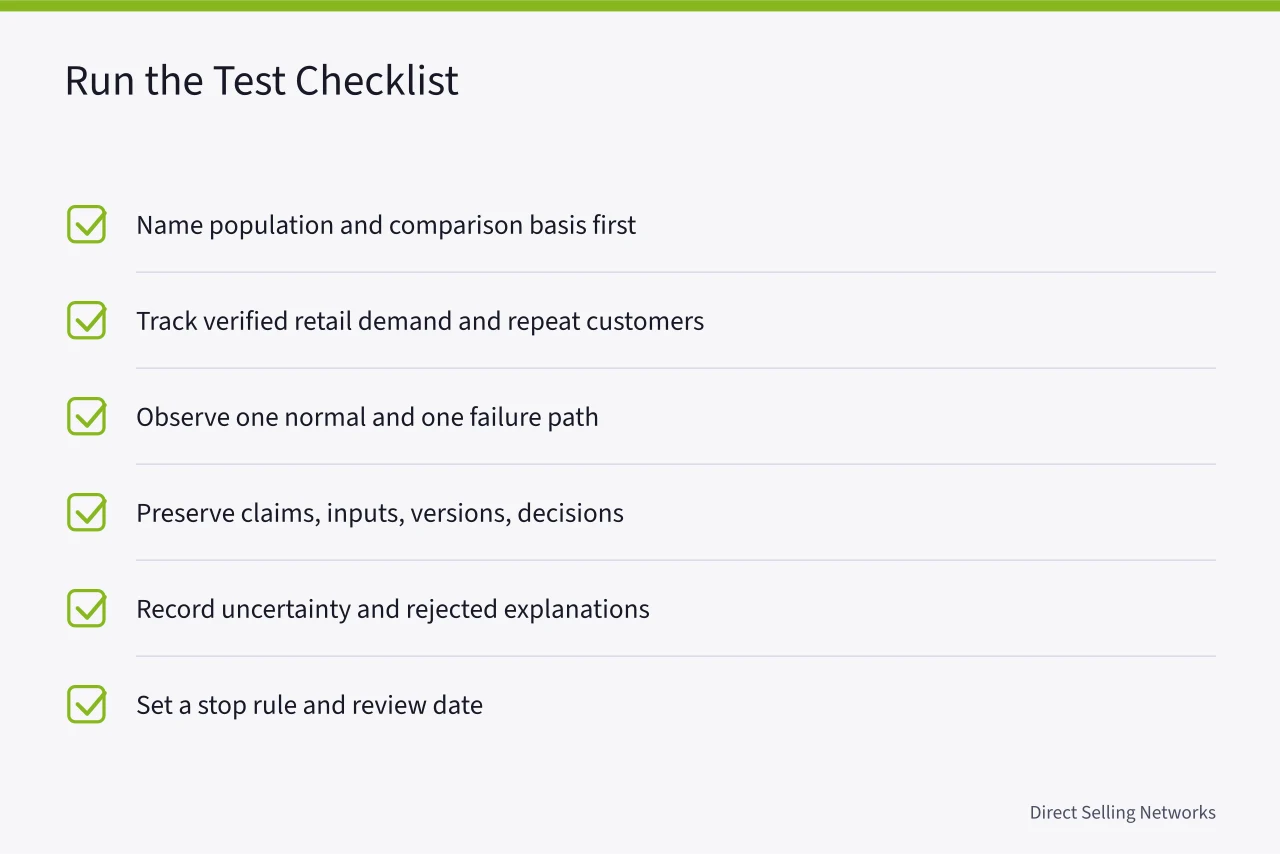
- Name the population and the comparison basis before the test starts
- Track verified retail demand and repeat customers, with cost and quality beside them
- Observe one normal path and one failure path
- Preserve claims, inputs, versions and decisions
- Record uncertainty and the explanations you rejected
- Set a stop rule and a review date
A worked example: a distributor copies Mary Kay's party model into a market with no in-person social cluster. The starting condition does not match, so the mechanism fails even though the original case succeeded. The correct output is a documented no, not a bigger push.
A documented no is a valid outcome, and the record is what makes it usable. For the wider strategic picture, see network marketing strategy.
Check the evidence before you cite it
The GAO data reliability guide treats data quality as a function of intended use and asks for a documented assessment.
The FTC advertising substantiation policy requires a reasonable basis for objective claims before you disseminate them. That applies to the exact promise, audience and qualification you publish, and it is enforced by the FTC and state attorneys general.
If a claim touches health or earnings, check the FTC's multi-level marketing business guidance and your state statute first.
Common questions
What is the first decision when copying an example?
Name the owner, the audience, the outcome and the evidence that would stop the work. Without a stop rule, every result gets read as encouragement.
How should an example be reviewed?
Review verified retail demand and repeat customers against cost, quality, exclusions, source limits and failures, then date the decision record. The review is about the mechanism, not the brand.
What should a team avoid?
Avoid income or lifestyle promises without suitable evidence. If an error reached a public or internal output, preserve the record and correct it where it appeared.
Do these examples transfer across countries?
No. Licensing, tax treatment and disclosure rules vary by country, state and province; confirm your own obligations with the IRS, the CRA or a licensed accountant.