

Costs
Part of Network marketing strategy: what to keep and what to drop
Network marketing strategy questions: what people ask and what is true
The questions distributors and small direct selling teams actually ask about strategy, and the honest answers, limits and checks behind each one.
What to take away
- The network marketing strategy questions that decide month three are earnings, classification, product claims, recruit cost and autoship retention, not motivation.
- Publish no earnings figure you cannot source to your Income Disclosure Statement. The FTC and the Direct Selling Association's self-regulatory arm both check.
- Classification follows the IRS control factors and the economic realities test, not the label in the agreement.
- Lead cost per recruit is total lead spend divided by recruits still active past your refund window.
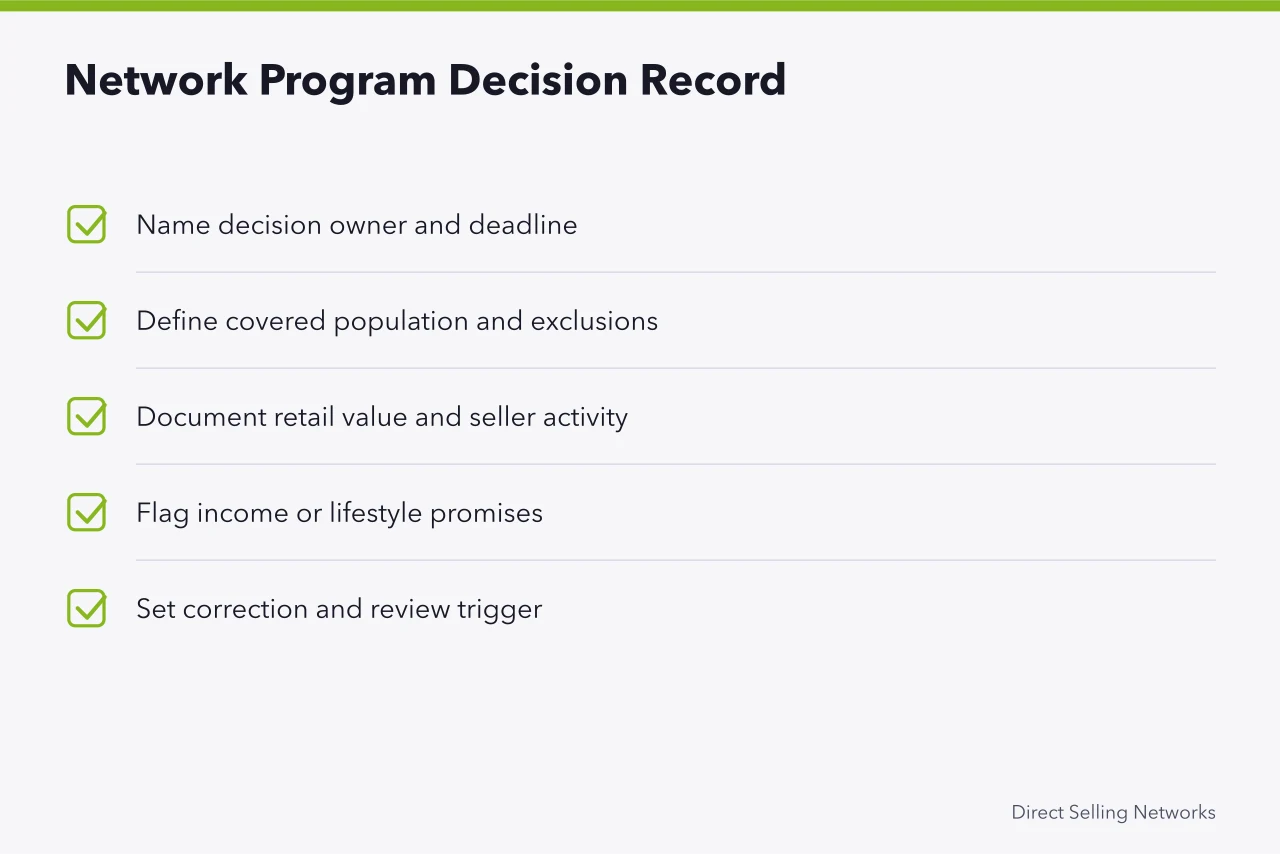
- Date every answer, name its source, and note when it expires.
The questions people actually ask
The same handful of questions reaches distributors in the first ninety days at Amway, Herbalife, Mary Kay, Young Living and Primerica. What will I earn, and when? Why did my commission not match my spreadsheet? Can I say this product cured something? Do I have to buy inventory? What happens if I quit?
Those are strategy questions, and they have checkable answers. They decide whether a person stays past month three. The answers live in the compensation plan, the Income Disclosure Statement, the distributor agreement, and your state's statutes. A training deck is not one of those four.
What will I earn, and when?
Nobody can promise a number. Amway, Herbalife, USANA, Nu Skin and Mary Kay publish Income Disclosure Statements, and the FTC's 2018 business guidance on multi-level marketing says commissions should follow sales to real customers rather than purchases by distributors. Herbalife's 2016 settlement cost $200 million and restructured its US compensation around retail sales.
If a distributor recruits R people, each of whom sells S in volume, and the plan pays P percent to a given depth, monthly override equals R times S times P. Substitute your own R, S and P from the plan document, then quote the IDS median for that rank. If the median is small, say so.
Payout timing is a separate answer. Most plans pay monthly on a cutoff date, with a holdback for returns. Name your cutoff day, your holdback window and your minimum payout threshold.
Am I an employee or a contractor?
The IRS decides this on behavioral and financial control, not on what the agreement calls the person. Behavioral control covers whether you dictate hours, routes and methods. Financial control covers who buys the tools, who carries the loss, and whether the worker can profit or lose on their own judgment.
IRS Publication 15-A and Revenue Ruling 87-41 list the factors, and Form SS-8 requests a formal determination.
A distributor who must attend daily meetings, follow a scripted pitch and buy a starter kit can look like an employee. Misclassification exposes the company to back payroll tax, interest and penalties.
The Department of Labor has applied an economic realities test to federal wage law, and California's AB 5 codified the ABC test. Confirm your facts with a licensed CPA or employment attorney.
Canadian distributors file T2125 and deduct business expenses under CRA rules. The categories differ from the US Schedule C, so do not hand a Canadian recruit a US deduction sheet. GST/HST registration generally applies above $30,000 in taxable revenue over four consecutive calendar quarters.
Can I say the product cured something?
No. Product claims fall under FDA and FTC rules, and a distributor repeating a claim is still making it. The two agencies sent joint warning letters over COVID-19 cure claims in 2020. Send medical questions to the FDA and to a qualified healthcare professional.
Reviews are the same trap. The FTC guidance for marketers using reviews warns about fake feedback, selective requests, conditioned incentives, hidden relationships and paid ranking.
The FTC's rule on fake reviews and testimonials, 16 CFR Part 465, took effect in October 2024 and carries civil penalties above $50,000 per violation. Free product for a five-star review is a conditioned incentive.
What does a recruit actually cost?
Lead cost per recruit equals total lead spend divided by recruits who stay active past your refund window. A vendor selling cheap leads looks expensive once that window closes.
Typical US lead prices as of 2026 run from under $5 for a shared or recycled list to $50 or more for an exclusive, real-time lead. Meta and Google lead-form campaigns commonly land between $10 and $40 per lead in competitive markets. At a 2 percent close rate, a $20 lead costs $1,000 per recruit before refunds.
Vet lead vendors on three points: where the leads come from, whether the prospect consented to contact, and how the vendor handles a do-not-call request. The FTC and state attorneys general treat unsolicited recruiting calls as telemarketing violations under the Telemarketing Sales Rule and the TCPA. Keep the vendor's written consent records.
Why does retention decide the plan?
Autoship volume that cancels in month two is not revenue. Track the percentage of new distributors still ordering at month three, six and twelve. That curve, not your enrollment count, tells you whether the plan works.
The Direct Selling Association has reported US retail sales in the mid-$30 billions in recent years across millions of sellers. Compare the shape of your own IDS rank curve with the published ones from Amway and Herbalife.
For a review method, the GAO evaluation design guide connects evaluation questions to evidence needs and design choices. Use that discipline when you test a new onboarding sequence, and avoid causal claims your data cannot support.
When AI tools touch a workflow, the NIST AI RMF Playbook lists voluntary actions organized around govern, map, measure and manage. It is not a certification or a ranking.
If your answers live on a page, table or form, the W3C information and relationships explanation explains that visual structure should also be available to screen readers. Test the actual page before you ship it.
Worked example: answering a commission complaint
A distributor says their payout is short by two hundred dollars. Run the same four checks every time.
Answering a commission complaint
- Pull the plan document version in force during the commission period.
- Recompute volume from the order records, not the distributor's spreadsheet.
- Check the cutoff date and any holdback for returns.
- Write the answer, the source, and the date the answer expires.
If the plan changed mid-period, the answer is two calculations, not one. Record both.
Where to get the strategy right
Start with the network marketing strategy material on plan design and disclosure before you draft a recruiting script. Then confirm every jurisdiction-specific point with your state attorney general's office, the FTC, the CRA for Canadian distributors, or a licensed CPA or attorney.
Read the FTC's business guidance on multi-level marketing, the DSSRC case decisions published by BBB National Programs, and IRS Publication 334 if you file a Schedule C.
Common questions
What is the first question to answer for a new distributor?
What the plan pays and when it pays. Give the arithmetic in the plan's own variables and point to the median in your Income Disclosure Statement. A number you cannot source is a claim you cannot defend.
Can a company require distributors to buy inventory?
Some plans require a starter kit or minimum autoship, and some states restrict it. The FTC's 2015 case against Vemma alleged an affiliate program that paid mainly for recruitment. Name your state, check its statutes and your distributor agreement, and get a licensed attorney's answer.
Is a network marketing plan a pyramid scheme?
The test is where the money comes from: sales to people outside the plan, or recruitment and internal purchases. The Ninth Circuit upheld a pyramid finding against BurnLounge in 2007 on that basis. Results vary, and a federal judge in Texas ruled for Neora in the FTC's 2023 case.
How do we vet a lead vendor?
Ask where the leads come from, whether the prospect consented to contact, and how the vendor handles do-not-call requests. Then track lead cost per recruit past your refund window. A vendor who will not show consent records is a compliance risk.
When should we update our published answers?
Whenever the plan, the IDS or the applicable state rule changes, and at least once a year. Date every answer and name its source so a reader can tell when it went stale.