Rules
Direct selling income disclosure statements: how to read them before you join
Line by line through a real income disclosure statement: median versus average, active definitions, autoship costs, and the fine print before you join.
Direct selling income disclosure statements: how to read them before you join
What to take away
- An income disclosure statement reports what a company's distributors earned, but the headline number is often an average lifted by a few top sellers.
- The median line is the one to compare against your own costs, because half of all participants earned less than it.
- Read the definitions of "active", the time period, and whether income is gross or net before you trust any figure.
- Check autoship minimums, renewal fees, and cooling-off rights, because those obligations decide whether you can break even.
- Keep your own records for a 1099-NEC or a CRA T2125 filing, since a disclosure statement is not a tax document.
What an income disclosure statement is and is not
A direct selling income disclosure statement is a company's summary of what its sellers earned over a set period. It is not a promise, and it is not standardized in the United States. No federal rule forces every network marketing company to publish one.
The FTC Act bars deceptive earnings claims, so a company that shows typical income must be able to support it. FTC Act language on unfair or deceptive practices applies to claims a recruiter makes, not just to the corporate website.
Many statements appear only because of past enforcement, state rules, or pressure from regulators in Canada. Read one as a floor, not a ceiling.
Median versus average: the gap that changes your math
Average income divides total payouts by the number of participants. A small group of high earners lifts that number. Median income is the middle value: half of participants earned more, half earned less.
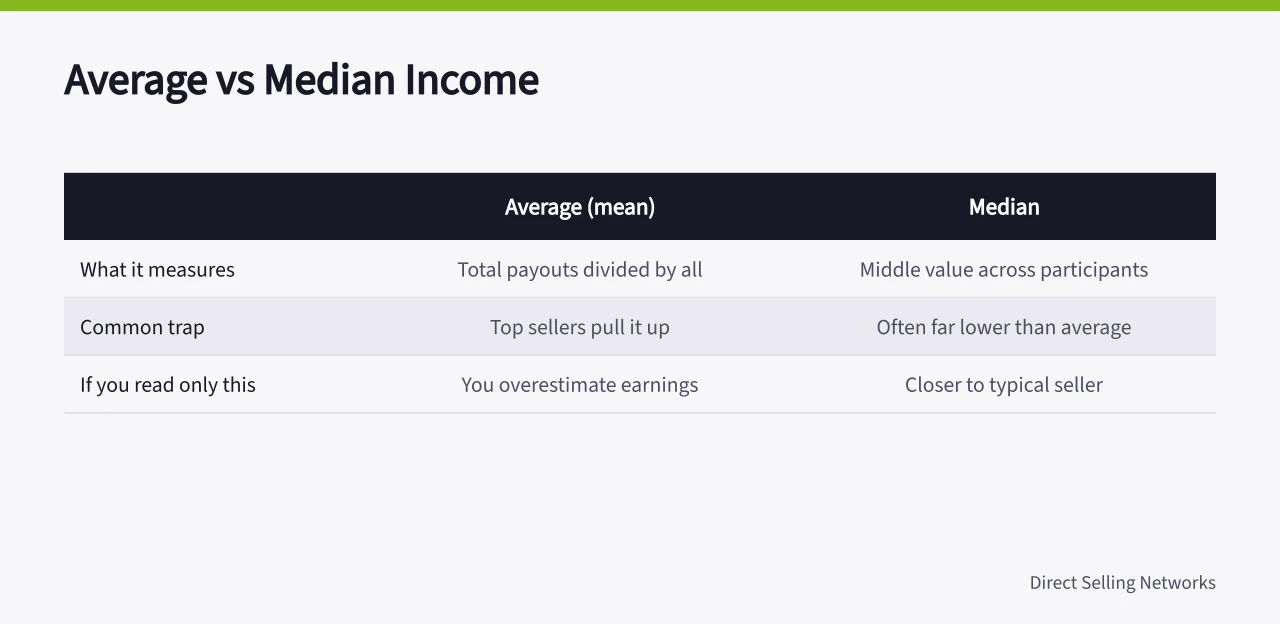
Statements often show both. The average can be several times the median. If you only read the average, you overestimate your likely earnings.
| Line on the statement | What it measures | Common trap |
|---|---|---|
| Average (mean) | Total payouts divided by all participants | Top sellers pull it up |
| Median | Middle value across all participants | Often far lower than the average |
| Active participant count | Sellers who met a monthly threshold | Excludes many who joined and quit |
| Gross income | Payouts before expenses | Ignores autoship, shipping, fees |
How to read the statement line by line
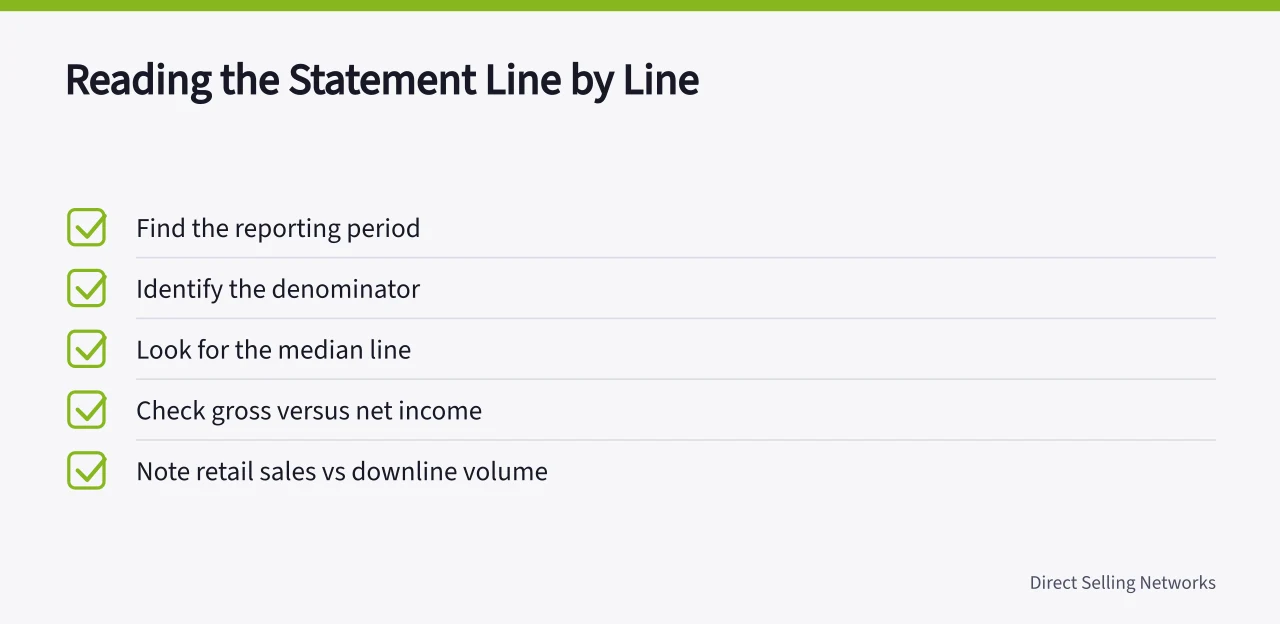
- Find the reporting period. A statement covering 12 months hides seasonality and churn.
- Identify the denominator. "All participants" includes people who joined and quit. "Active" may require a monthly autoship order.
- Look for the median line. If the document shows only an average, treat that as a warning sign.
- Check whether income is gross or net. Gross ignores product purchases, shipping, and fees you paid.
- Note whether the company counts retail sales or only downline volume. The mix matters when you build a network marketing strategy that keeps retail demand and payout records in agreement.
Example: reading a typical disclosure page
A typical page lists several income brackets. It might say most participants earned between $0 and $100, while the top 1 percent earned far more.
Look for the definition of "active". Many companies require a personal purchase or autoship each month. That cost never appears in the income figure.
Look for the note on "income from downline" versus "retail profit". A statement that lumps them together hides whether the business needs customers outside the seller's household.
A disclosure statement that shows only an average, with no median and no definition of "active", tells you more about the company's marketing than about your likely earnings.
The fine print: costs, timelines, and cancellation
- Autoship minimumhow much product you must buy each month to stay active.
- Renewal or annual feethe charge that keeps your distributor account open.
- Shipping and handlingusually excluded from the income figures.
- Cooling-off windowthe FTC Cooling-Off Rule gives three days to cancel certain sales made away from a permanent place of business. Some states add longer periods for direct sales.
Income claims and the recruiting script
A recruiter's script is not the disclosure statement. If the script promises a range of earnings, ask for the page that supports it.
Canada's Competition Act covers multi-level marketing and income representations. Competition Act sections require income claims to be accurate and not misleading.
Recruiting scripts, income claims, and autoship math hide the mistakes that sink teams. Network marketing strategy mistakes explains each trap and the way around it.
Tax lines most readers skip
A disclosure statement is not a tax form. In the US, commissions paid to an independent contractor are reported on Form 1099-NEC. IRS 1099-NEC explains which payments go on that form.
You may also receive a 1099-MISC for certain payments. Track every product purchase, shipping charge, and event fee, because those reduce taxable profit. In Canada, self-employed distributors report on Form T2125.
Compare this with direct selling in 2027, where retail demand, disclosed costs, and supervised field conduct decide whether a distributor stays.