Strategy
Part of Direct selling: a focused business guide for 2027
Real direct selling examples that hold up under scrutiny
Named direct selling cases, from Amway to Avon, show what income disclosures can be checked, what stays private, and where the model breaks down.
What to take away
- Amway, Avon, Herbalife, Nu Skin, Mary Kay and Primerica are the cases worth studying, and each is documented somewhere public.
- The checkable record is an income disclosure statement, a 10-K segment, or a court docket, not a distributor's social post.
- Every one of these companies has been sued or investigated over income claims, so read the case and the complaint together.
- A case transfers only when your starting condition, cost and retention match the one you are copying.
- Keep retail customer sales separate from recruitment volume when you test any of it.
The cases worth naming
Amway is the oldest and most litigated. The FTC's 1979 ruling separated its model from a pyramid scheme because it required retail sales to people outside the network. That decision is still the reference point for how US regulators read a compensation plan.
Avon sells through representatives with no recruitment requirement at all. Its 10-K filings report representative counts and revenue by region, which makes it the cleanest public comparison for a single-level model.
Herbalife settled with the FTC in 2016 for $200 million and agreed to restructure its US business so distributor rewards tracked retail sales rather than recruitment. Read the settlement order if you want the compliance language a plan has to survive.
Nu Skin, Mary Kay and Primerica round out the list. Nu Skin discloses mainland China revenue separately because that market uses a different legal structure. Mary Kay publishes a US income disclosure statement with earnings by rank. Primerica reports a licensed sales force because its representatives must hold securities and insurance licenses.
| Company | What it shows | Where the record sits |
|---|---|---|
| Amway | Retail-sales requirement keeps a plan outside the pyramid definition | FTC 1979 ruling |
| Avon | Single-level selling with no recruitment requirement | Annual 10-K |
| Herbalife | 2016 FTC settlement and US plan restructure | FTC settlement order |
| Mary Kay | Earnings by rank, published yearly | Income disclosure statement |
| Primerica | Licensed sales force, regulated products | 10-K and state licensing records |
Read the record, not the testimonial
An income disclosure statement is the only place a company has to show what typical distributors actually earn, and the FTC has pushed for them since the Herbalife case. Read the median, not the top rank. The gap between the two is the honest picture of the plan.
For a Canadian distributor, business income and expenses go on form T2125 business income with the CRA, and the deduction rules differ from the US Schedule C. Confirm the current treatment with a licensed CPA before you file either one.
The FTC advertising substantiation policy requires a reasonable basis for objective earnings claims before they go out. That applies to a recruiting post exactly as it applies to a national ad.
Test a case before you copy it
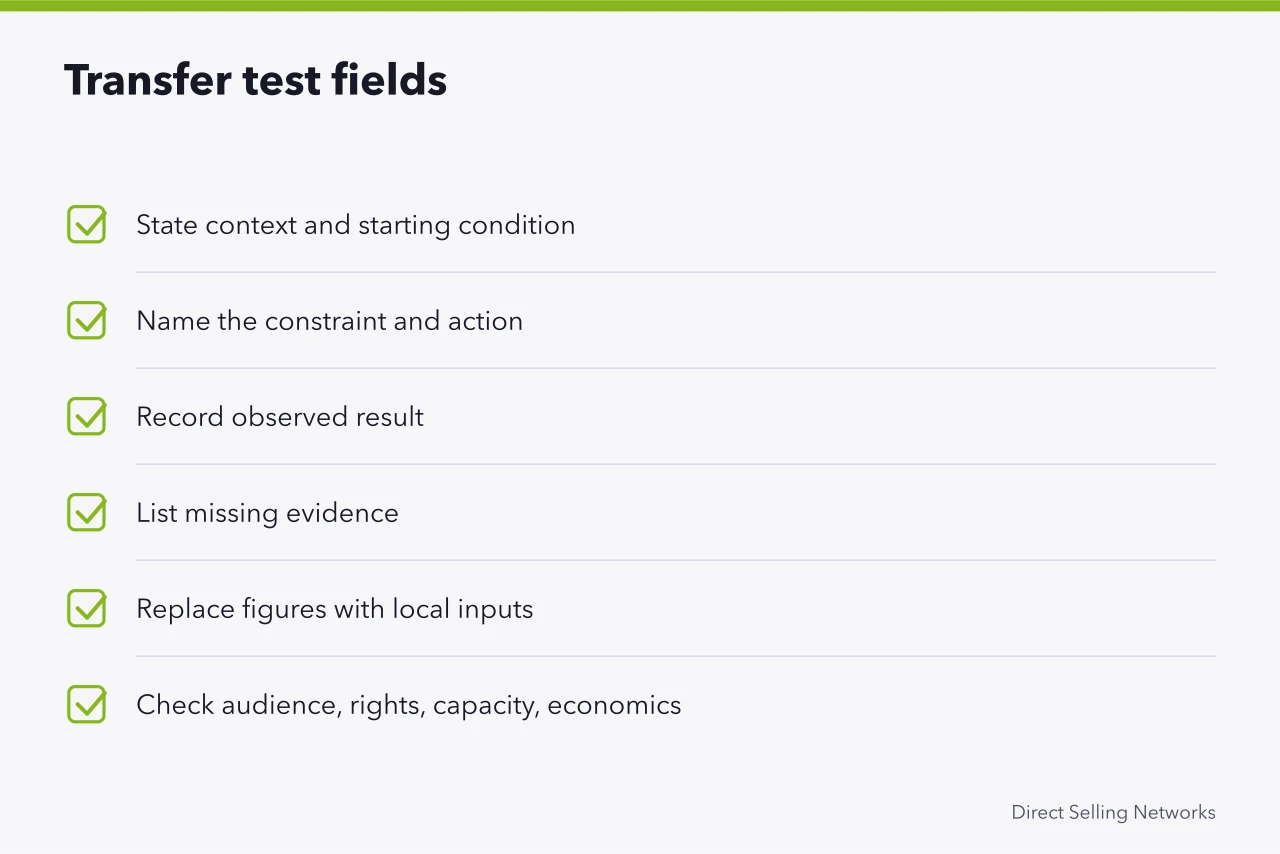
- Write down the case's starting conditionmarket, year, product price, and pay plan.
- Pull its disclosure statement or 10-K and record the median earnings figure.
- List what the record does not show, such as attrition or refund rates.
- Substitute your own cost per recruit, autoship rate and refund rate into the plan math.
- Set a stop ruleif retail customer sales do not cover the cost of recruiting, halt.
The GOV.UK open standards guidance is a useful prompt for portability, but it governs UK public-service work and says nothing about a pay plan.
Where these cases break
The failure pattern is the same across all six. Recruitment volume gets read as proof of customer demand, autoship renewals get counted as retail sales, and the plan pays out on the first while the second quietly shrinks.
Herbalife's settlement exists because of that gap. Amway's 1979 ruling exists because of it too. When you audit your own numbers, separate a distributor's personal consumption from a sale to someone who is not a distributor.
The GOV.UK technology selection guidance and the CISA logging guidance cover system ownership and record retention. Neither proves a business result, and neither substitutes for your own transaction records.
Common questions
What makes a direct selling example credible?
A public document does: an FTC order, a 10-K, or a company income disclosure statement. A distributor's screenshot of a bonus check is not evidence, because you cannot check the rank, the period or the downline behind it.
Which company should a new distributor study first?
Avon, if you want the simplest model, because it sells without a recruitment requirement and reports representative counts. Amway, if you want the legal test, because the 1979 FTC ruling still defines where a plan crosses into a pyramid scheme.
Do income disclosure statements cover all distributors?
No. They typically report US active distributors by rank and exclude anyone who did not qualify in the period. Read the footnotes for the definition of active, because that definition changes the median.
Can I copy a plan that worked for another company?
Only after substituting your own cost per recruit, refund rate and autoship retention into the math. A plan that pays on recruitment in a market with weak retail demand will collapse regardless of which company ran it first.