Rules
Network marketing strategy case studies: what worked and what failed
FTC settlements, autoship math, and tax forms shape network marketing strategy case studies. See what worked, what failed, and the numbers behind each case.
What to take away
- Documented network marketing strategy case studies show three repeated traits: income claims, autoship pressure, and pay plans that reward recruiting over retail.
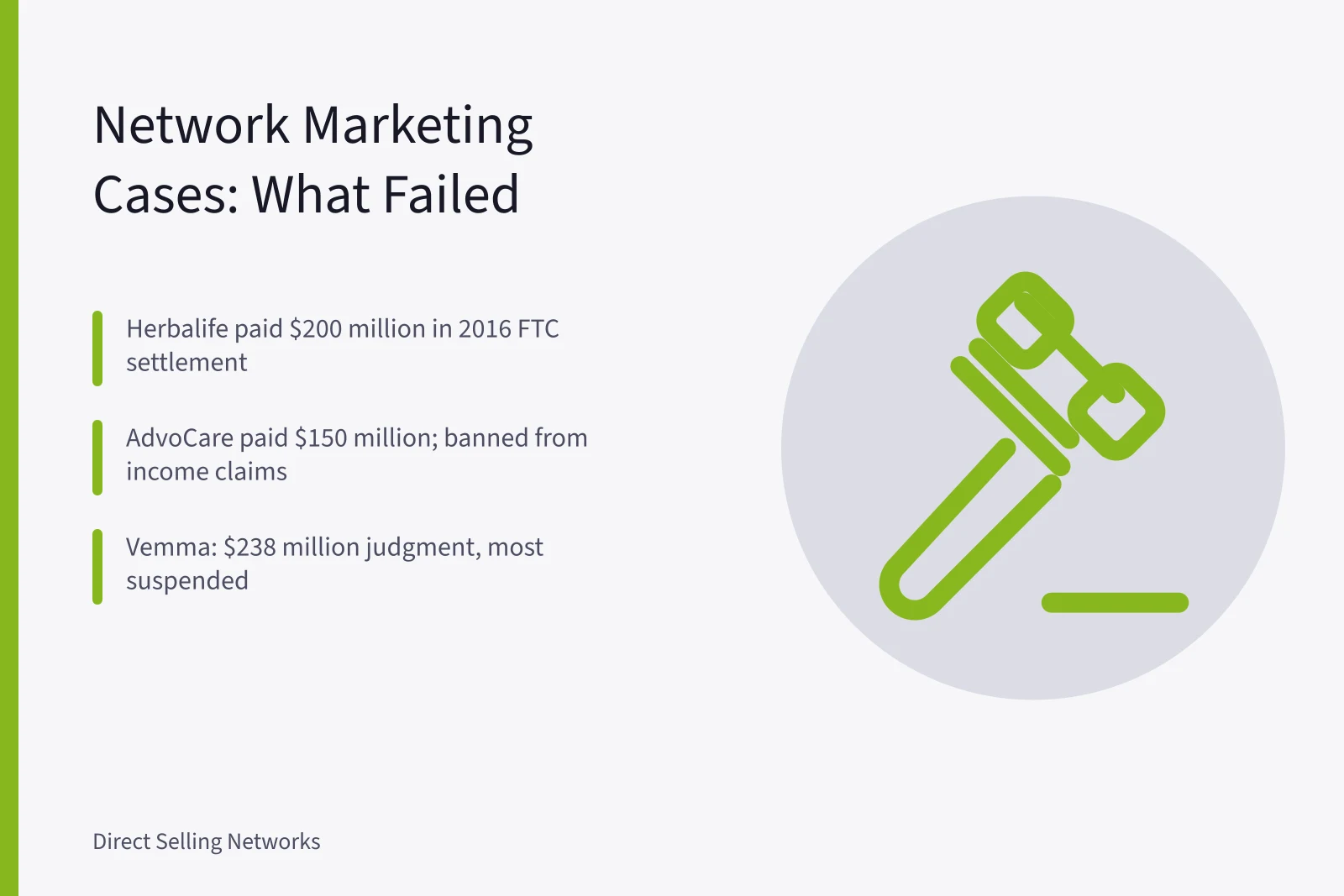
- The Herbalife settlement in 2016 required $200 million in consumer redress and a restructured compensation plan.
- AdvoCare paid $150 million in 2019 to settle FTC charges that its model operated as a pyramid.
- LuLaRoe agreed to pay $4.75 million in 2020 after the FTC alleged its model rewarded recruitment over sales.
- A network marketing success and failure analysis points to one test: retail demand, disclosed costs, and seller conduct must line up.
Real cases that changed the numbers
| Case | Year | Payment | Condition that changed |
|---|---|---|---|
| Herbalife | 2016 | $200 million | Split retail sales from recruiting rewards |
| AdvoCare | 2019 | $150 million | Banned from certain income claims |
| LuLaRoe | 2020 | $4.75 million | Changed compensation and refund policies |
These settlements are network marketing strategy examples with public numbers. Each company faced allegations that it paid distributors for enrolling others rather than selling products to end users. The FTC Act gives the agency authority over unfair methods of competition, which is the legal basis for these cases.
FTC Network Marketing Settlements
- 200 millionHerbalife 2016 payment
- 150 millionAdvoCare 2019 payment
- 4.75 millionLuLaRoe 2020 payment
The numbers matter because they show what regulators treat as a violation. A pay plan that rewards recruitment can be legal only if retail sales are real and documented. When retail sales are thin, the structure looks like a pyramid.
Example: Vemma and the autoship trap
In 2015 the FTC won a case against Vemma. A court entered a $238 million judgment, but most was suspended. Vemma paid $470,000 in cash and assets. New affiliates had to buy expensive product packs and maintain autoship to qualify for commissions.
Vemma Autoship Trap
$238 million | judgment entered against Vemma
$470,000 | cash and assets actually paid
Autoship required to qualify for commissions
Most participants lost money, FTC alleged
That condition is the trap. Autoship turns a business into a monthly expense. If a seller cannot resell the product, the commission cannot cover the cost. The FTC alleged that most participants lost money. That is a documented failure pattern.
The Vemma order also banned certain earnings claims. It required clear disclosures about typical results. Those terms are now a reference point for other cases.
A checklist for judging a plan
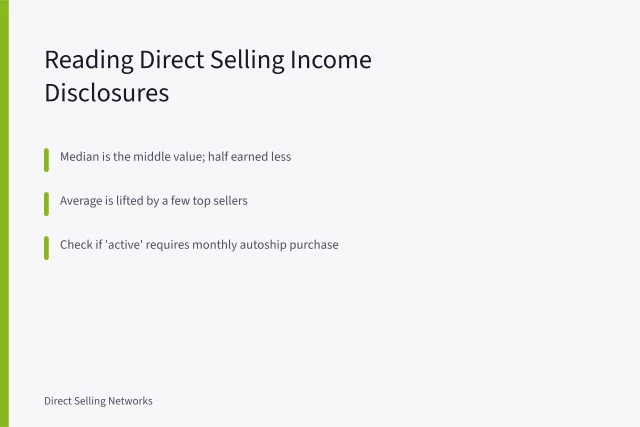
- Find the income disclosure statement and read the percentage of sellers at each rank.
- Add up the monthly autoship cost, the starter kit, and any annual fees.
- Confirm whether commissions require personal recruitment or only product sales.
- Check the refund window and the cooling-off rule that applies to your state.
The cooling-off rule gives consumers three days to cancel certain sales. For a new seller who buys a starter kit, that window can be the difference between a trial and a loss.
Run the numbers for three months. If the autoship cost exceeds your expected retail margin, the plan fails the test. If commissions require two levels of recruitment, the plan carries legal risk.
Where the failures show up
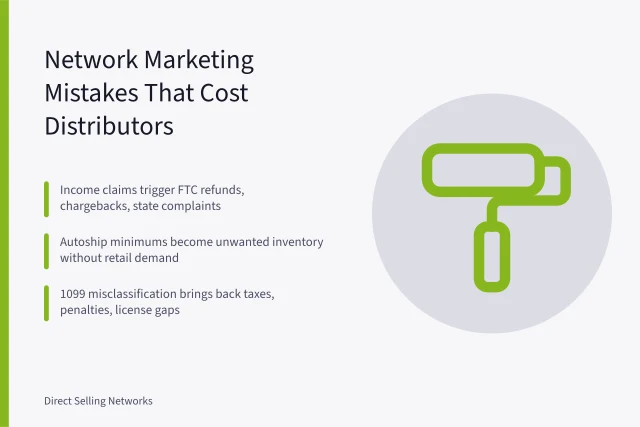
The pattern repeats in the network marketing strategy mistakes that sink teams: scripts that promise income, autoship math that hides losses, and pay timelines that stretch past a seller's patience.
Income claims are the most common trigger. The FTC has brought cases against companies that used earnings claims without typical results. A simple rule: if a claim cannot be supported by a disclosure statement, treat it as a risk.
Autoship math is another failure point. A monthly order with a commission rate below the order total creates a loss. Sellers who cannot resell the product pay to stay active. That cost is often invisible in recruiting presentations.
How a durable strategy looks
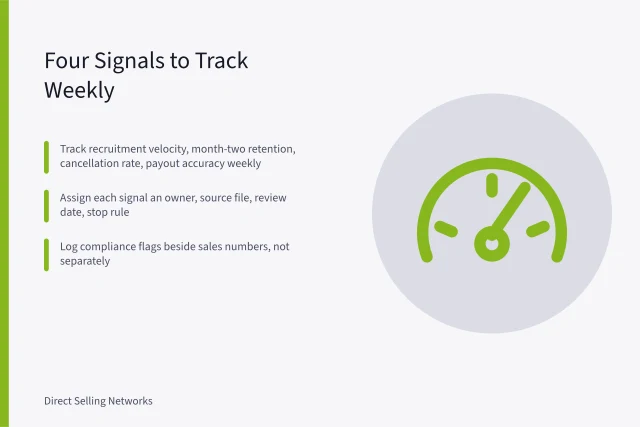
To build a strategy that holds, compare three records: retail demand, seller conduct, and payout history. A plan that pays leaders for recruiting volume will eventually break when recruitment slows. A plan that pays for retail sales can survive a slowdown.
The FTC's 2016 Herbalife order required the company to separate retail sales from recruiting rewards. The order also required a compliance program and a compliance officer. That network marketing strategy lesson is a template. If your plan cannot show retail sales to nonparticipants, the model is fragile.
Direct selling in 2027
The direct selling guide for 2027 explains how disclosed costs and supervised field conduct replace recruitment volume as growth metrics. That shift matters for anyone judging a plan today. The direct selling case studies in this article show why the shift is not optional.
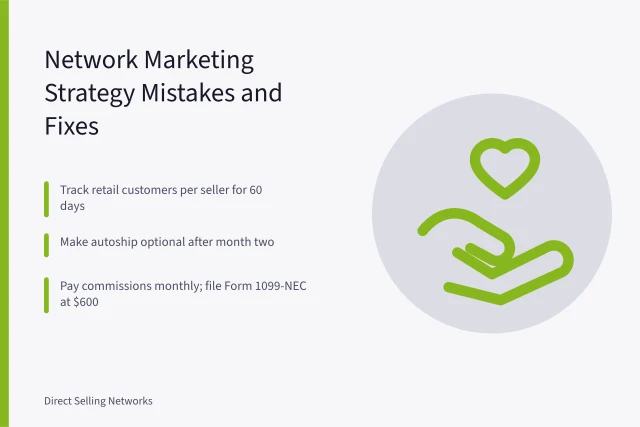
Tax reporting also changes the math. Network marketing independent contractors typically receive Form 1099-NEC for nonemployee compensation. That form reports payments of $600 or more. Sellers must track expenses to offset that income.